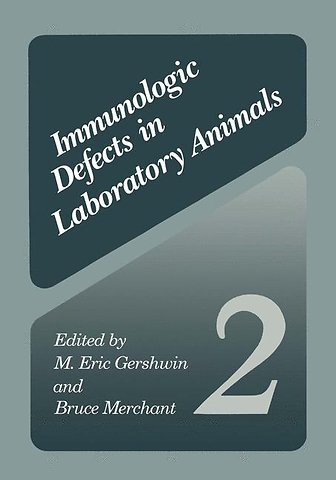
Immunologic Defects in Laboratory Animals 2
Paperback Engels 2012 9781468486544Samenvatting
Tiselius demonstrated that the immunologically active components of immune sera migrated electrophoretically in the gamma globulin region. His findings illuminated the classic observations of Jenner regarding development of resistance to infection, and those of von Pirquet, Pasteur, and Arthus regarding the transfer and specificity of resistance. Conceptual integration of these observations provided the impetus for the present modern era of immunology. Subsequent to Tiselius's work, multiple, rapid advances have occurred in the study of congenital and acquired immune deficiency states in mice, chickens, and humans. These studies have readily demonstrated that the immunologic ability of an organ ism to protect itself from environmental influences is a prerequisite for survival. Indeed, this necessity for protection from microenvironmental influences has promoted the evolu tionary development of immunologic diversification, namely, host dependence upon a sophisticated, multifaceted network of cells and effector mechanisms responsible for the clearance and neutralization of toxins and potentially harmful pathogens. The obligate dependence of animals upon the functional integrity of their immunologic systems is illus trated by the ready invasion of ubiquitous organisms when the host is in a state of immune defense derangement. Nevertheless, derangements in immune function can range from par tial to complete and can be compatible with survival. The consequences of such derange ments run the gamut from subclinical disease to inevitable mortality.
Specificaties
Lezersrecensies
Rubrieken
- advisering
- algemeen management
- coaching en trainen
- communicatie en media
- economie
- financieel management
- inkoop en logistiek
- internet en social media
- it-management / ict
- juridisch
- leiderschap
- marketing
- mens en maatschappij
- non-profit
- ondernemen
- organisatiekunde
- personal finance
- personeelsmanagement
- persoonlijke effectiviteit
- projectmanagement
- psychologie
- reclame en verkoop
- strategisch management
- verandermanagement
- werk en loopbaan