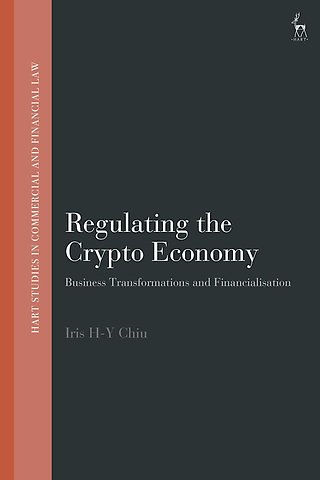
Regulating the Crypto Economy
Business Transformations and Financialisation
Gebonden Engels 2021 1e druk 9781509935741Samenvatting
This book focuses on the building of a crypto economy as an alternative economic space and discusses how the crypto economy should be governed. The crypto economy is examined in its productive and financialised aspects, in order to distil the need for governance in this economic space.
The author argues that it is imperative for regulatory policy to develop the economic governance of the blockchain-based business model, in order to facilitate economic mobilisation and wealth creation. The regulatory framework should cater for a new and unique enterprise organisational law and the fund-raising and financing of blockchain-based development projects. Such a regulatory framework is crucially enabling in nature and consistent with the tenets of regulatory capitalism.
Further, the book acknowledges the rising importance of private monetary orders in the crypto economy and native payment systems that do not rely on conventional institutions for value transfer. A regulatory blueprint is proposed for governing such monetary orders as 'commons' governance. The rise of Decentralised Finance and other financial innovations in the crypto economy are also discussed, and the book suggests a framework for regulatory consideration in this dynamic landscape in order to meet a balance of public interest objectives and private interests.
By setting out a reform agenda in relation to economic and financial governance in the crypto economy, this forward-looking work argues for the extension of 'regulatory capitalism' to this perceived 'wild west' of an alternative economic space. It advances the message that an innovative regulatory agenda is needed to account for the economically disruptive and technologically transformative developments brought about by the crypto economy.
Specificaties
Lezersrecensies
Inhoudsopgave
I. Introduction to the Book
II. Bitcoin and the Beginnings of a Blockchain-based Economy
A. The Bitcoin Blockchain as a Payment System? Issues and Problems in the Light of the Institutions of Law and Regulation of Payments
B. Cryptocurrency and the Law and Regulation of Money
III. Smart Contracts, the Ethereum Blockchain and the Rise of the Crypto Economy
A. Permissioned Blockchain and Business Networks
B. Permissionless Blockchains
C. Issues Particular to Off -chain Legs
D. Dispute Resolution, Crisis Management and the Governance of a Commons
E. The Decentralised Autonomous Organisation
IV. Tokenisation and Financing
A. Fundraising by Blockchain-based Developers and Tokenisation
B. ICOs and Challenges in Regulatory Classifications
V. The Need for Law Reform
2. Rise of the Productive Crypto Economy and the Need for Regulation
I. Regulatory Capitalism
II. The Productive Crypto Economy: Three New Forms of Commoditisation
A. New Virtual Goods and Services in the Productive Crypto Economy
B. New Distributed Models of Peer-to-peer Services
C. New Tokenisation of Existing Real Economy Assets
III. A Blueprint for a Regulatory Agenda
A. Why the Token Taxonomy is Not Sufficient
B. The Need to Avoid Merely Focusing on Financial Regulation
IV. Co-regulation in Policy Development
3. Financial Regulators' Approaches to the Crypto Economy
I. Regulatory Divergences
II. Overview of Regulatory Approaches
III. Facilitative but Permissive Regimes
IV. Facilitative but Restrictive Regime – The US Regulatory Approach
V. Enabling Tailor-Made/Special Regimes
A. Thailand
B. Individual European Jurisdictions Prior to the European Commission Proposal 2020
C. EU Regulatory Regime for Cryptoassets
VI. Critical Reflections on Global Regulators' Approaches
4. Facilitating the Crypto Economy: The Law of Business Organisations and Governance
I. Introduction to the Organisational Perspective of Blockchain-based Business
II. What Organisational Form for Blockchain-based Business?
III. The Applicability of Existing Organisational Regimes in Law
A. The Company
B. Social Enterprise Forms
C. The Cooperative
D. The Limited Liability Partnership
E. Adapted Corporate Organisational Form
F. New Legal Organisational Form?
IV. Separate Legal Personality
V. An Enabling Legal Framework and Conclusion
5. The Financing of Blockchain-based Business Development and the Need for Regulation
I. Why a Tailor-made Regulatory Regime for Fundraising is Needed
A. Why Distinguish ICOs from Securities and Crowdfunding Regulation
B. Similarities to and Differences from Initial Public Offers
C. Similarities to and Differences from Equity Crowdfunding
D. Should ICOs be Regulated by Product Governance Generally?
II. A Blueprint for Regulating Token Financing
III. Mandatory Disclosure
A. Information Relating to the Development Team that Signals Integrity
C. Information Relating to the Nature of the Pre-sold Tokens, their Anticipated Rights and Functionality, and their Pricing at the ICO
D. Information Relating to the Development Team's Relationships with Third Parties
E. Other Information Relating to the Details Required for the Schedule of Commitment
IV. Ex Post Monitoring and Rights in a Schedule of Commitment
A. Schedule of Commitment for Addressing Investors' Investment Risk
B. Schedule of Commitment for Investors' Agency Risk
C. Schedule of Commitment in Relation to Public Interest Concerns
D. How Mandatory Disclosure and the Schedule of Commitment Protect Investors – Consequences of Breach
E. Is Dual-class Financing an Issue?
V. Establishing a Unique Regulatory Regime for Pre-development Fundraising
6. Regulating the Monetary Order of the Crypto Economy
I. The Private Monetary Order in the Crypto Economy
A. Private Stablecoins
B. Interoperable Coins
II. The Objectives for Regulating the Payment Systems in the Crypto Economy
III. The Regulation of the Payment and Mining Protocols in Terms of Payment Functionalities and Standards
A. Regulatory Oversight for Payment Functionalities
B. Regulation of Miners?
IV. Regulating Key Payment Service Providers – Wallets and Custodial Services Providers
A. Types of Wallets
B. Customer Protection
C. Anti-money Laundering
D. Rise of Non-fungible Token Custody Providers?
V. Regulating Cryptocurrency Exchanges
A. Coherentist Extension of Securities Markets Regulation?
B. New Regulatory Regimes for Cryptocurrency Exchanges
C. Regulating Centralised and Decentralised Features of Exchanges
D. Marketplaces for Non-fungible Tokens?
VI. Central Bank Digital Currencies and the Crypto Economy
A. The Development of Central Banks' Thinking Regarding Digital Versions of Fiat Currencies
B. CBDC for the Crypto Economy?
VII. Concluding Remarks
7. Regulating Crypto Finance
I. Productive and Hyper Forms of Financialisation
A. Policy Choice for Productive Financialisation
B. Policy Choices for Hyper-fi nancialisation
II. Trends in Regulating Crypto Finance
A. Crypto Hedge Funds, Derivatives and Exchange-traded Products
B. Bank-based Platform Coins
C. Coins with Dollar Parity
D. Cryptoasset Service Providers
E. Novelties for Regulatory Policy: Asset-referenced Stablecoins
F. Novelties for Regulatory Policy: DeFi
III. A Framework for Developing the Regulatory Agendas for Crypto Finance
A. The Development of Regulatory Ontologies and Need for Dynamism
B. Regulators Need to Approach Regulatory Design with an Open Mind
C. Regulators Need to Consider Reframing or Reform of Regulatory Standards and Content
D. Regulators Need to Consider Agility in Regulatory Architecture to Respond to Crypto Finance Developments
Anderen kochten ook
 Syren Johnstone€ 214,30
 Paul Vigna€ 9,99
 Maarten de Borst€ 31,95
 Laurie Ritzen€ 79,–
 Frederieke Hegger€ 8,99
 Iason van der Meulen€ 35,–
Rubrieken
- advisering
- algemeen management
- coaching en trainen
- communicatie en media
- economie
- financieel management
- inkoop en logistiek
- internet en social media
- it-management / ict
- juridisch
- leiderschap
- marketing
- mens en maatschappij
- non-profit
- ondernemen
- organisatiekunde
- personal finance
- personeelsmanagement
- persoonlijke effectiviteit
- projectmanagement
- psychologie
- reclame en verkoop
- strategisch management
- verandermanagement
- werk en loopbaan