Op werkdagen voor 23:00 besteld, morgen in huis Gratis verzending vanaf €20
-
Inloggen

Uw winkelwagen

Naar winkelwagen Verder winkelen
Uitdagingen + oplossingen
Alle uitdagingen + oplossingen
  • Direct naar
    • Alle uitdagingen en oplossingen
    • Meest bekeken managementvragen
    • Recent gestelde vragen
    • Stel jouw managementvraag
    • Boeken als cadeau
  • Ontdek oplossingen per thema
    • Boekadviezen en geschenken
    • Digitalisering en technologie
    • Communicatie en onderhandeling
    • Compliance en regelgeving
    • alle thema’s
  • Voorbeelden
    • Boekcadeau voor promotie
    • AI toepassen op werk
    • Versterken interne communicatie
    • Voorkomen corruptie en onethisch gedrag
    • alle vragen
Managementboeken
Alle managementboeken
  • Direct naar
    • Boeken als cadeau
    • Managementboek TOP 100
    • AI-books
    • Managementuitdagingen
    • Auteur in de spotlight
    • Online Magazine
    • Binnenkort verwacht
    • Aanbiedingen
    • Trending trefwoorden
  • Rubrieken
    • Advisering
    • Algemeen management
    • Coaching en trainen
    • Communicatie en media
    • Economie
    • Financieel management
    • Inkoop en logistiek
    • Internet en social media
    • IT-management / ICT
    • Juridisch
    • Leiderschap
    • Marketing
    • Mens en maatschappij
    • Non-profit
    • Ondernemen
    • Organisatiekunde
    • Personal finance
    • Personeelsmanagement
    • Persoonlijke effectiviteit
    • Projectmanagement
    • Psychologie
    • Reclame en verkoop
    • Strategisch management
    • Verandermanagement
    • Werk en loopbaan
    • alle rubrieken
Overige boeken
Alle overige boeken
  • Direct naar
    • Bestseller 60
    • Fictie TOP 20
    • Non-fictie TOP 20
    • Spanning TOP 20
    • Jeugd TOP 10
    • Culinair TOP 10
    • Aanbiedingen
    • Boeken als cadeau
  • Rubrieken
    • Cadeauboeken
    • Computer en informatica
    • Economie
    • Filosofie
    • Flora en fauna
    • Geneeskunde
    • Geschiedenis
    • Gezondheid
    • Informatief / professioneel
    • Jeugd
    • Juridisch
    • Koken en eten
    • Kunst en cultuur
    • Literatuur en romans
    • Mens en maatschappij
    • Naslagwerken
    • Paramedisch
    • Psychologie
    • Reizen
    • Religie
    • Schoolboeken
    • Spiritualiteit
    • Sport, hobby, lifestyle
    • Thrillers en spanning
    • Wetenschap en techniek
    • Woordenboeken en taal
Interactief leren
Alle seminars & trainingen
  • Direct naar
    • Live events
    • Online training
    • AI-books
  • Online Magazine
    • Previews
    • Recensies
    • Interviews
    • Podcasts
    • Videos
  • Volg ons op
    • Spotify
    • YouTube
    • Instagram
    • Linkedin
Attenderingen
Aanbevelingen instellen
  • Algemeen
    • Recht op u af
    • Juridisch
    • Expertselectie juridisch
    • Series
    • Herdrukken
    • Wetenschappelijk
  • Aanbevolen per ministerie
    • Algemene Zaken
    • Binnenlandse Zaken en Koninkrijksrelaties
    • Buitenlandse Zaken
    • Defensie
    • Economische Zaken
    • Financiën
    • Infrastructuur en Waterstaat
    • Justitie en Veiligheid
    • Landbouw, Visserij, Voedselzekerheid en Natuur
    • Onderwijs, Cultuur en Wetenschap
    • Nationale Politie
    • Sociale Zaken en Werkgelegenheid
    • Volksgezondheid, Welzijn en Sport
Abonnementen
Abonnementencatalogus
  • Algemeen
    • Uw abonnementen
    • Verlengen / opzeggen
    • Openstaande claims
    • Bibliografische wijzigingen
    • Abonnementshouders
    • Afleveradressen
    • Referenties
    • Notities
  • Aanbevolen per ministerie
    • Algemene Zaken
    • Binnenlandse Zaken en Koninkrijksrelaties
    • Buitenlandse Zaken
    • Defensie
    • Economische Zaken
    • Financiën
    • Infrastructuur en Waterstaat
    • Justitie en Veiligheid
    • Landbouw, Visserij, Voedselzekerheid en Natuur
    • Onderwijs, Cultuur en Wetenschap
    • Nationale Politie
    • Sociale Zaken en Werkgelegenheid
    • Volksgezondheid, Welzijn en Sport
Boekseries
Boekseriecatalogus
  • Algemeen
    • Uw serieabonnementen
    • Geadresseerden
    • Abonnementshouders
    • Afleveradressen
    • Referenties
    • Notities
  • Aanbevolen per ministerie
    • Algemene Zaken
    • Binnenlandse Zaken en Koninkrijksrelaties
    • Buitenlandse Zaken
    • Defensie
    • Economische Zaken
    • Financiën
    • Infrastructuur en Waterstaat
    • Justitie en Veiligheid
    • Landbouw, Visserij, Voedselzekerheid en Natuur
    • Onderwijs, Cultuur en Wetenschap
    • Nationale Politie
    • Sociale Zaken en Werkgelegenheid
    • Volksgezondheid, Welzijn en Sport
Nu lezen
Online Magazine
  • Direct naar
    • Recensies
    • Interviews
    • Previews
    • Opinie
    • Actueel
    • Podcasts
    • Videos
  • Lees over
    • Algemeen management
    • Coachen en trainen
    • Leiderschap
    • Marketing
    • Organisatiekunde
    • Strategisch management
    • Verandermanagement
    • meer onderwerpen
  • Recente artikelen
Meer
  • Meer
    010-4731397
    Klantenservice
    Mijn account
    Mijn bestellingen
    010-4731397
    Boeken IT-management / ICT Microservices in Action
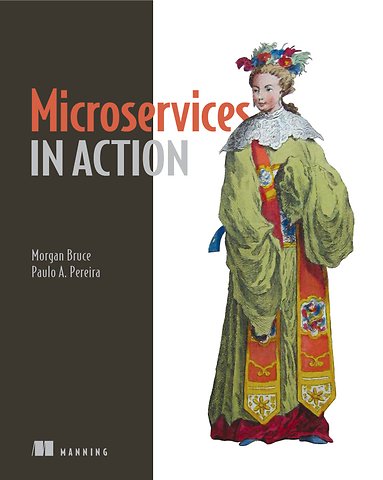
    Microservices in Action
    Microservices in Action
    Morgan Bruce Meer over de auteurs
    Morgan Bruce, Paulo Pereira

    Microservices in Action

    Paperback Engels 2019 1e druk 9781617294457
    € 66,11
    In winkelwagen
    Levertijd ± 11 werkdagen
    Gratis verzonden

    Samenvatting

    Microservices promise a better way to sustainably deliver business impact. Rather than a single monolithic unit, applications built in this style are composed from loosely-coupled, autonomous services.

    Microservices in Action is a practical book about building and deploying microservice-based applications. Written for developers and architects with a solid grasp of service-oriented development, it tackles the challenge of putting microservices into production.

    Key features
    - Review of microservice architecture
    - Written by authors with daily, hands-on experience
    - Building a delivery pipeline for microservices

    Readers should be intermediate developers with some knowledge of enterprise application architecture.

    Microservices change the dev process, maximizing the efficiency and independence of small teams. To be successful, developers, team leaders, and architects need to master both the implementation details and the big picture of how microservices work in a production environment.

    Morgan Bruce and Paulo A. Pereira have years of experience building distributed applications, with particular expertise in the high-stakes finance and identity verification industries. They work daily with microservices in a production environment using the tools and techniques presented in this book.

    Trefwoorden

    microservicesdistributed systemsdevopssoftware architectuurcontainerscontinuous deliveryservice discoverymonitoringkubernetesdeploymentresiliencedomain driven designdockerobservabilityci/cdscalabilityapi gatewayevent-driven architectureservice meshfault toleranceloggingfault tolerancelogging
    microservicesdistributed systemsdevopssoftware architectuurcontainerscontinuous deliverymonitoringservice discoverykubernetesdomain driven designdeploymentresilienceobservabilityci/cddockerevent-driven architecturescalabilityservice meshapi gatewayloggingfault toleranceloggingfault tolerance

    Specificaties

    ISBN13:9781617294457
    Taal:Engels
    Bindwijze:paperback
    Aantal pagina's:392
    Uitgever:Manning Publications
    Druk:1
    Verschijningsdatum:25-1-2019
    Hoofdrubriek:IT-management / ICT
    Serie:In action
    Thema:
    UFL Ondernemingssoftware
    UM Computerprogrammering / softwareontwikkeling
    UMW Webprogrammeren
    UMX Programmeren en scripttalen: algemeen
    UYD Systeemanalyse en systeemontwerp

    Lezersrecensies

    Wees de eerste die een lezersrecensie schrijft!
    Schrijf een recensie
    Lees ons recensiebeleid
    Uw waardering
    ?
    Log in om uw waardering te geven
    Klik om uw waardering te geven

    Inhoudsopgave

    PART 1: THE LAY OF THE LAND
    1 DESIGNING AND RUNNING MICROSERVICES
    1.1 What is a microservice application?
    1.1.1 Scaling through decomposition
    1.1.2 Key principles
    1.1.3 Who uses microservices?
    1.1.4 Why are microservices a good choice?
    1.2 What makes microservices challenging?
    1.2.1 Design challenges
    1.2.2 Operational challenges
    1.3 Microservice development lifecycle
    1.3.1 Designing microservices
    1.3.2 Deploying microservices
    1.3.3 Observing microservices
    1.4 Responsible and operationally aware engineering culture
    Summary

    2 MICROSERVICES AT SIMPLEBANK
    2.1 What does SimpleBank do?
    2.2 Are microservices the right choice?
    2.2.1 Risk and inertia in financial software
    2.2.2 Reducing friction and delivering sustainable value
    2.3 Building a new feature
    2.3.1 Identifying microservices by modeling the domain
    2.3.2 Service collaboration
    2.3.3 Service choreography
    2.4 Exposing services to the world
    2.5 Taking your feature to production
    2.5.1 Quality-controlled and automated deployment
    2.5.2 Resilience
    2.5.3 Transparency
    2.6 Scaling up microservice development
    2.6.1 Technical divergence
    2.6.2 Isolation
    2.7 What’s next?
    Summary

    PART 2: DESIGN
    3 ARCHITECTURE OF A MICROSERVICE APPLICATION
    3.1 Architecture as a whole
    3.1.1 From monolith to microservices
    3.1.2 The role of an architect
    3.1.3 Architectural principles
    3.1.4 The four tiers of a microservice application
    3.2 A microservice platform
    3.2.1 Mapping your runtime platform
    3.3 Services
    3.3.1 Capabilities
    3.3.2 Aggregation and higher order services
    3.3.3 Critical and noncritical paths
    3.4 Communication
    3.4.1 When to use synchronous messages
    3.4.2 When to use asynchronous messages
    3.4.3 Asynchronous communication patterns
    3.4.4 Locating other services
    3.5 The application boundary
    3.5.1 API gateways
    3.5.2 Backends for frontends
    3.5.3 Consumer-driven gateways
    3.6 Clients
    3.6.1 Frontend monoliths
    3.6.2 Micro-frontends
    Summary
    4 DESIGNING NEW FEATURES
    4.1 A new feature for SimpleBank
    4.2 Scoping by business capabilities
    4.2.1 Capabilities and domain modeling
    4.2.2 Creating investment strategies
    4.2.3 Nested contexts and services
    4.2.4 Challenges and limitations
    4.3 Scoping by use case
    4.3.1 Placing investment strategy orders
    4.3.2 Actions and stores
    4.3.3 Orchestration and choreography
    4.4 Scoping by volatility
    4.5 Technical capabilities
    4.5.1 Sending notifications
    4.5.2 When to use technical capabilities?
    4.6 Dealing with ambiguity
    4.6.1 Start with coarse-grained services
    4.6.2 Prepare for further decomposition
    4.6.3 Retirement and migration
    4.7 Service ownership in organizations
    Summary

    5 TRANSACTIONS AND QUERIES IN MICROSERVICES
    5.1 Consistent transactions in distributed applications
    5.1.1 Why can’t you use distributed transactions?
    5.2 Event-based communication
    5.2.1 Events and choreography
    5.3 Sagas
    5.3.1 Choreographed sagas
    5.3.2 Orchestrated sagas
    5.3.3 Interwoven sagas
    5.3.4 Consistency patterns
    5.3.5 Event sourcing
    5.4 Queries in a distributed world
    5.4.1 Storing copies of data
    5.4.2 Separating queries and commands
    5.4.3 CQRS challenges
    5.4.4 Analytics and reporting
    5.5 Further reading
    5.6 Summary

    6 DESIGNING RELIABLE SERVICES
    6.1 Defining reliability
    6.2 What could go wrong?
    6.2.1 Sources of failure
    6.2.2 Cascading failures
    6.3 Designing reliable communication
    6.3.1 Retries
    6.3.2 Fallbacks
    6.3.3 Timeouts
    6.3.4 Circuit breakers
    6.3.5 Asynchronous communication
    6.4 Maximizing service reliability
    6.4.1 Load balancing and service health
    6.4.2 Rate limits
    6.4.3 Validating reliability and fault tolerance
    6.5 Safety by default
    6.5.1 Frameworks
    6.5.2 Service mesh
    Summary

    7 BUILDING A REUSABLE MICROSERVICE FRAMEWORK
    7.1 A microservice chassis
    7.2 What’s the purpose of a microservice chassis?
    7.2.1 Reduce risk
    7.2.2 Faster bootstrapping
    7.3 Designing a chassis
    7.3.1 Service discovery
    7.3.2 Observability
    7.3.3 Balancing and limiting
    7.4 Exploring the feature implemented using the chassis
    7.5 Wasn’t heterogeneity one of the promises of microservices?
    7.6 Summary

    PART 3: DEPLOYMENT
    8 DEPLOYING MICROSERVICES
    8.1 Why is deployment important?
    8.1.1 Stability and availability
    8.2 A microservice production environment
    8.2.1 Features of a microservice production environment
    8.2.2 Automation and speed
    8.3 Deploying a service, the quick way
    8.3.1 Service startup
    8.3.2 Provisioning a virtual machine
    8.3.3 Run multiple instances of your service
    8.3.4 Adding a load balancer
    8.3.5 What have you learned?
    8.4 Building service artifacts
    8.4.1 What’s in an artifact?
    8.4.2 Immutability
    8.4.3 Types of service artifacts
    8.4.4 Configuration
    8.5 Service to host models
    8.5.1 Single service to host
    8.5.2 Multiple static services per host
    8.5.3 Multiple scheduled services per host
    8.6 Deploying services without downtime
    8.6.1 Canaries and rolling deploys on GCE
    Summary

    9 DEPLOYMENT WITH CONTAINERS AND SCHEDULERS
    9.1 Containerizing a service
    9.1.1 Working with images
    9.1.2 Building your image
    9.1.3 Running containers
    9.1.4 Storing an image
    9.2 Deploying to a cluster
    9.2.1 Designing and running pods
    9.2.2 Load balancing
    9.2.3 A quick look under the hood
    9.2.4 Health checks
    9.2.5 Deploying a new version
    9.2.6 Rolling back
    9.2.7 Connecting multiple services
    Summary

    10 BUILDING A DELIVERY PIPELINE FOR MICROSERVICES
    10.1 Making deploys boring
    10.1.1 A deployment pipeline
    10.2 Building a pipeline with Jenkins
    10.2.1 Configuring a build pipeline
    10.2.2 Building your image
    10.2.3 Running tests
    10.2.4 Publishing artifacts
    10.2.5 Deploying to staging
    10.2.6 Staging environments
    10.2.7 Deploying to production
    10.3 Building reusable pipeline steps
    10.3.1 Procedural versus declarative build pipelines
    10.4 Techniques for low-impact deployment and feature release
    10.4.1 Dark launches
    10.4.2 Feature flags
    Summary

    PART 4: OBSERVABILITY AND OWNERSHIP
    11 BUILDING A MONITORING SYSTEM
    11.1 A robust monitoring stack
    11.1.1 Good monitoring is layered
    11.1.2 Golden signals
    11.1.3 Types of metrics
    11.1.4 Recommended practices
    11.2 Monitoring SimpleBank with Prometheus and Grafana
    11.2.1 Setting up your metric collection infrastructure
    11.2.2 Collecting infrastructure metrics—RabbitMQ
    11.2.3 Instrumenting SimpleBank’s place order
    11.2.4 Setting up alerts
    11.3 Raising sensible and actionable alerts
    11.3.1 Who needs to know when something is wrong?
    11.3.2 Symptoms, not causes
    11.4 Observing the whole application
    Summary

    12 USING LOGS AND TRACES TO UNDERSTAND BEHAVIOR
    12.1 Understanding behavior across services
    12.1.1 Useful information to include in log entries
    12.1.2 Structure and readability
    12.2 Generating consistent, structured, human-readable logs
    12.2.1 Useful information to include in log entries
    12.2.2 Structure and readability
    12.3 Setting up a logging infrastructure for SimpleBank
    12.3.1 ELK- and Fluentd-based solution
    12.3.2 Setting up your logging solution
    12.3.3 Configure what logs to collect
    12.3.4 Finding a needle in the haystack
    12.3.5 Logging the right information
    12.4 Tracing interactions between services
    12.4.1 Correlating requests: traces and spans
    12.4.2 Setting up tracing in your services
    12.5 Visualizing traces
    Summary

    13 BUILDING MICROSERVICE TEAMS
    13.1 Building effective teams
    13.1.1 Conway’s Law
    13.1.2 Principles for effective teams
    13.2 Team models
    13.2.1 Grouping by function
    13.2.2 Grouping across functions
    13.2.3 Setting team boundaries
    13.2.4 Infrastructure, platform, and product
    13.2.5 Who’s on-call?
    13.2.6 Sharing knowledge
    13.3 Recommended practices for microservice teams
    13.3.1 Drivers of change in microservices
    13.3.2 The role of architecture
    13.3.3 Homogeneity versus technical flexibility
    13.3.4 Open source model
    13.3.5 Design review
    13.3.6 Living documentation
    13.3.7 Answering questions about your application
    13.4 Further reading
    Summary

    APPENDIXES
    APPENDIX A: INSTALLING JENKINS ON MINIKUBE
    A.1 Running Jenkins on Kubernetes
    A.1.1 Setting up Helm
    A.1.2 Create a namespace and a volume
    A.1.3 Installing Jenkins
    A.1.4 Configuring RBAC
    A.1.5 Testing it all works
    Afgekapt op 63 regels

    Managementboek Top 100

    Bekijk de volledige Managementboek Top 100
    € 66,11
    Levertijd ongeveer 11 werkdagen
    Gratis verzonden

    Rubrieken

    • advisering
    • algemeen management
    • coaching en trainen
    • communicatie en media
    • economie
    • financieel management
    • inkoop en logistiek
    • internet en social media
    • it-management / ict
    • juridisch
    • leiderschap
    • marketing
    • mens en maatschappij
    • non-profit
    • ondernemen
    • organisatiekunde
    • personal finance
    • personeelsmanagement
    • persoonlijke effectiviteit
    • projectmanagement
    • psychologie
    • reclame en verkoop
    • strategisch management
    • verandermanagement
    • werk en loopbaan
    Uw cookie-instellingen
    Deze website maakt gebruik van verschillende soorten cookies. Sommige cookies worden geplaatst door diensten van derden die op onze pagina's worden weergegeven. Om deze externe content te kunnen tonen is nodig dat u toestemming geeft voor het zetten van persoonlijke en marketingcookies. U kunt uw toestemming op elk moment wijzigen of intrekken. In onze cookieverklaring vindt u meer informatie.

    Functionele cookies
    Deze zijn noodzakelijk voor de werking van de website, zonder deze cookies kan de website niet naar behoren werken.

    Persoonlijke en marketingcookies
    Wij gebruiken cookies voor statistieken om bij te houden en rapportages te krijgen over hoe bezoekers de website gebruiken. Zo kunnen wij onze website verbeteren. Marketingcookies worden gebruikt om bezoekers te volgen wanneer ze verschillende websites bezoeken. Hun doel is advertenties weergeven die zijn toegesneden op en relevant zijn voor de individuele gebruiker.
    Op werkdagen voor 23:00 besteld, morgen in huis Gratis verzending vanaf €20

    Klantenservice

    Over ons Contact Voorwaarden Bestellen en retourneren Lezen en luisteren Voor auteurs Recensiebeleid Partnerprogramma

    Zakelijk

    Zakelijke diensten Partnerprogramma Cadeaubonnen

    Altijd op de hoogte

    Schrijf u in voor onze nieuwsbrief en blijf up-to-date met relevante interviews en recensies, inspirerende events en de beste acties.
    PRETTIG KENNIS MAKEN
    Thuiswinkel waarborg Algemene voorwaarden Colofon Privacy Cookies Cookie instellingen Toegankelijkheidsverklaring Service & Contact Over ons
    © 2026 Mainpress BV

    Producten

      Auteurs

        Trefwoorden

          Artikelen

            Microservices in Action

            Microservices in Action
            Morgan Bruce , Paulo Pereira
            /
            loader
            Recensiebeleid
            AI-book

            Wat is een AI-book?

            Een AI-book is niet een boek dat geschreven is door AI maar een boek dat verrijkt is met AI. Het maakt de inhoud van een boek interactief via WhatsApp, zodat je ermee kunt chatten. Zie het als een razend slimme assistent die het boek perfect begrijpt en er alles uit onthouden heeft. Jij kunt deze assistent alles vragen. Vraag bijvoorbeeld hoe je iets kunt toepassen op jouw persoonlijke situatie, om een korte samenvatting, of wat de belangrijkste inzichten zijn. AI-books zijn alleen te gebruiken via WhatsApp, je hoeft er geen aparte app voor te installeren.
            Meer informatie over AI-books

            ?

            Geef uw beoordeling

            Microservices in Action

            Verwijder uw beoordeling