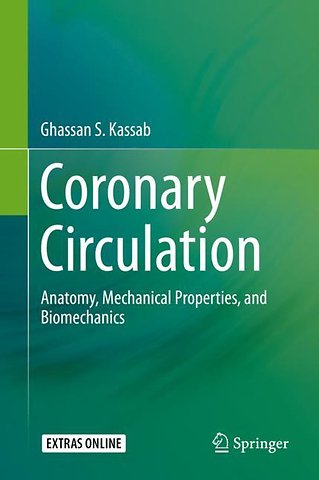
Coronary Circulation
Anatomy, Mechanical Properties, and Biomechanics
Gebonden Engels 2019 9783030148171Samenvatting
This comprehensive text examines both global and local coronary blood flow based on morphometry and mechanical properties of the coronary vasculature. Using a biomechanical approach, this book addresses coronary circulation in a quantitative manner based on models rooted in experimental data that account for the various physical determinants of coronary blood flow including myocardial-vessel interactions and various mechanisms of autoregulation. This is the first text dedicated to a distributive analysis (as opposed to lumped) and provides digital files for detailed anatomical data (e.g., diameters, lengths, node-to-node connections) of the coronary vessels. This book also provides appendices with specific mathematical formulations for the biomechanical analyses and models in the text. Written by Dr. Ghassan S. Kassab, a leader in the field of coronary biomechanics, Coronary Circulation: Anatomy, Mechanical Properties, and Biomechanics is a synthesis of seminal topics in the field and is intended for clinicians, bioengineers, and researchers as a compendium on the topic. The detailed anatomical and mechanical data provided are intended to be used as a platform to address new questions in this exciting and clinically very important research area.
Specificaties
Lezersrecensies
Inhoudsopgave
<p>Preface</p>
<p>Overview, Scope, Goal of Book, Acknowledgments</p>
<p>Chapter 1: Biomechanics<br></p>
<p>1.1 Introduction</p>
<p>1.2 Basic Terminology in Biomechanics </p>
<p>Stress, </p>
<p>Strain</p>
<p>Compliance, Stiffness, Distensibility, and Young’s Modulus, </p>
<p>Viscoelasticity</p>
<p>1.3 Approach</p>
<p>1.4 Structure and Geometry</p>
<p>1.5 Material Properties</p>
<p>1.6 Laws of Mechanics</p>
<p>1.7 Boundary Conditions</p>
<p>1.8 Boundary Value Problems</p>
<p>1.9 Solution of Boundary Value Problems</p>
<p>Computational Fluid Dynamics</p>
<p>Finite Element Method, Fluid-Structure Interaction</p>
<p>ALE Formulation for Fluid-Structure-Interaction</p>
<p>Immersed Boundary (IB) Method</p><p><br></p>
<p>Chapter 2: Morphometry of Coronary Vasculature<br></p>
<p>2.1 Introduction</p>
<p>2. 2 Coronary Vasculature</p>
<p>2.3 Reduction of Coronary Vasculature</p>
<p>Casting Material</p>
<p>Animal and Isolated Heart Preparation</p>
<p>Polymer Cast of Coronary Vasculature</p>
<p>Histological and Cast Specimens </p>
<p>Morphometric Measurements</p><p>Diameter-Defined Strahler System</p>
<p>Meshing of Histological and Cast Data</p>
<p>Segments and Elements</p>
<p>Connectivity Matrix</p>
<p>Longitudinal Position Matrix</p>
<p>Asymmetry Ratios</p>
<p>Counting Total Number of Elements</p>
<p>Arcade-Like Vessels: Epicardial Veins</p>
<p>Network-Like Vessels: Capillaries</p>
<p>Diameters and Lengths of Capillary Segments</p>
<p>Topology of Arteriolar and Venular Zones and Mean Functional Capillary Length </p>
<p>2. 4 Integration of 3D Coronary Vasculature<br></p>
<p>Node to Node Computer Reconstruction of Coronary Network</p>
<p>Anatomical Input Files</p>
<p>Statistical 3D Reconstruction of Coronary Vasculature</p>
<p>Existing database and Additional Assumptions</p>
<p>Reconstruction Approach</p>
<p>Geometric Optimization</p>
<p>Verification of Coronary Network </p>
<p>2.5 Non-Tree Structures</p>
<p>2.6 Labor Savings in Morphological Reconstruction</p>
<p>2.7 Automation: Segmentation and Centerline Detection</p>
<p>Image Processing</p>
<p>Segmentation of Vessel Boundary</p>
<p>Segmentation under Topological Control</p>
<p>Centerline Detection</p>
<p>Vector Field</p>
<p>Determination of the Centerlines</p>
<p>Geometric Reconstruction</p>
<p>2.8 Grid Generation</p><p>Element Quality</p>
<p>2.9 Visualization of Reconstructed Network</p>
<p>2.10 Patient Specific Coronary Morphometry</p><p><br></p>
<p>Chapter 3: Mechanical Properties and Microstructure of the Coronary Vasculature<br></p><p></p>
<p>3.1 Introduction</p>
<p>3.2 Compliance, Distensibility, and Stiffness</p>
<p>Epicardial Arteries</p>
<p>Capillaries </p>
<p>3.3 Effect of Surrounding Tissue: Radial Constraint and Tethering</p>
<p>Pressure-Cross Sectional Area Relation</p>
<p>Pressure-Volume Relation</p>
<p>Slackness between Vessels and Myocardium</p>
<p>3.4 Zero-Stress State</p>
<p>Circumferential Residual Strain</p>
<p>Longitudinal Distribution of Mean Stress and Strain </p>
<p>Transmural Wall Strain Distribution</p>
<p>Effect of No-Load Duration on Opening Angle</p>
<p>Effect of Osmolarity on Zero-Stress State</p>
<p>Axial Residual Strain</p>
<p>3.5 Tri-axial Testing of Coronary Arteries</p>
<p>Two-Layer Model</p>
<p>3.6 Active Mechanical Properties</p>
<p>Isovolumic Myography</p>
<p>3.7 Ultrastructure of Coronary Arteries </p>
<p>Intima</p>
<p>Media</p>
<p>Adventitia</p>
<p>Collagen and Elastin</p>
<p>Ground Substance</p>
<p>Histology</p>
<p>Multi-Photon Microscopy</p>
<p>Morphometry of coronary adventitia </p>
<p>Simultaneous mechanical loading-imaging</p>
<p>Morphometry of elastin and collagen fibers at no-distension state</p>
<p>In situ deformation of elastin and collagen fibers </p>
<p>Morphometry of coronary Media</p>
<p>Automation of Smooth Muscle Cell Measurements</p>
<p>In situ deformation of Smooth Muscle Cells </p>
<p> </p>
<p>Chapter 4: Constitutive Models of Coronary Vasculature</p>
<p>4.1 Introduction</p>
<p>4.2 Phenomenological Constitutive Models</p>
<p>Shear Modulus</p>
<p>Incremental Moduli</p>
<p>Strain Energy Function (SEF)</p>
<p>2D and 3D SEF Fung Model</p>
<p>Bilinear Model – Generalized Hooke’s Law</p>
<p>Shear Modulus</p>
<p>Incompressibility Condition</p>
<p>Linear Viscoelasticity and Maxwell’s Model</p>
<p>Artery</p>
<p>Opening Angle</p>
<p>Active Properties</p>
<p>4.3 Microstructure-based Constitutive models</p>
<p>Comparison of microstructural models</p>
<p>4.4 Microstructural models of Coronary Artery</p><p>Adventitia</p>
<p>Uniform field models – Behavior of Ground Substance</p>
<p>3D Microstructural model of coronary adventitia</p>
<p>Media</p>
<p>Integrated 3D Model of Coronary Artery Wall</p>
<p>Case I</p>
<p>Case II</p>
<p>Case III</p>
<p> <br></p>
<p>Chapter 5: Network Analysis of Coronary Circulation: I. Steady State Flow</p>
<p>5.1 Introduction</p>
<p>5.2 Steady State Coronary Blood Flow</p>
<p>Longitudinal Pressure and Flow Distributions </p>
<p>Coronary Arterial Tree Model: Statistical Connectivity</p>
<p>Coronary Arterial Tree Model: Node-to-Node Connectivity</p>
<p>Spatial Heterogeneity of Coronary Flow</p>
<p>Steady Flow Analysis in a 3D Coronary Arterial Model</p>
<p>Flow Heterogeneity with Fractal Nature</p>
<p>Role of Vascular Compliance </p>
<p>Pressure-Flow Relation in Single Coronary Artery</p>
<p>Role of Compliance and Blood Rheology on Pressure-Flow Relation in Entire Coronary Arterial Tree</p>
<p>Capillary Network Flow Analysis</p>
<p>Venous Network Flow Analysis</p>
<p>5.3 Structure-Function Relation</p>
<p>Transition from “Distributing” to “Delivering” Vessels</p>
<p>Transition from “Conduction” to “Transport”</p>
<p>Possible Mechanisms for Functional Hierarchy</p>
<p>Significance of Functional Hierarchy</p>
<p> </p>
<p>Chapter 6: Network Analysis of Coronary Circulation: II. Pulsatile Flow</p>
<p>6.1 Introduction</p>
<p>6.2 Pulsatile Flow in Coronary Vasculature</p>
<p>Pulsatile Flow Experiments in Passive Hearts</p>
<p>Womersley-Type Model</p>
<p>Low Frequency Flow Model Compared with Steady-State Flow</p>
<p>Experimental Validation of Womersley ModelEffect of Various Parameters (e.g., Wave Frequency, Branching Asymmetry, etc.) on Pulsatile Blood Flow</p>
<p>Hybrid One-Dimensional/Womersley Model</p>
<p>Pressure Boundary Conditions at the Inlet of LAD and LCx Arteries</p>
<p>Effect of Energy Loss at Bifurcation</p>
<p>6.3 Myocardial-Vessel Interaction Flow</p>
<p>Models of Coronary Vasculature</p>
<p>Intramyocardial Pressure (IMP)</p>
<p>Lumped Models</p>
<p>Distributive Models</p>
<p>Vessel Elasticity</p>
<p>MVI Model</p>
<p>Anatomical Model</p>
<p>Single Vessel Flow Model</p>
<p>Network Flow Model</p>
<p>Model Predictions</p>
<p>Phasic Changes</p>
<p>Test of MVI Mechanisms</p>
<p>6.4 Coronary Flow Regulation</p>
<p>Coronary Autoregulation</p>
<p>Models of Autoregulation</p>
<p>Perfusion Dispersion</p>
<p>Transmural Perfusion Heterogeneity</p>
<p>Metabolic Flow Reserve (MFR)</p>
<p>Effect of Regulation on the Coronary Flow</p>
<p>Model Predictions</p>
<p>Effect of MVI</p>
<p>Model Sensitivity</p>
<p>Myogenic sensitivity</p>
<p>Shear Sensitivity</p>
<p>Metabolic Sensitivity</p>
<p>Order Dependence of the Metabolic Diameter Regulation</p>
<p>Model Validations</p>
<p>Novel Model Predictions </p>
<p> </p>
<p>Chapter 7: Scaling Laws of Coronary Vasculature<br></p>
<p>7.1 Introduction </p>
<p>7.2 Murray’s Law</p>
<p>7.3 Zhou, Kassab, and Molloi ZKM Model</p>
<p>Validation of ZKM Model</p>
<p>Experimental Validations</p>
<p>Computational Validations</p>
<p>7.4 Validation of Scaling Laws in Other Vascular Trees</p>
<p>Optimal Power Dissipation</p>
<p>Vascular Metabolic Dissipation of Blood Vessel Wall</p>
<p>7.5 Scaling Law of Flow Resistance</p>
<p>7.6 Scaling of Myocardial Mass </p>
<p>7.7 Scaling Law of Vascular Blood Volume </p>
<p>Comparison with ZKM Model</p>
<p>7.8 Scaling laws of flow rate, vessel blood volume, vascular lengths, and transit times with number of capillaries</p>
<p>Flow Scales with Capillary Numbers</p>
<p>Crown Volume Scales with Capillary Number</p>
<p>Crown Length Scales with Capillary Number</p>
<p>Transit Time Scales with Crown Volume and Length</p>
<p>7.9 Other Design Features of Vascular Trees</p>
<p>7.10 Fractal Description of Branching Pattern </p>
<p>7.11 Intraspecific Scaling Laws of Vascular Trees </p>
<p>7.12 Constructal Law</p>
<p> <br></p>
<p>Chapter 8: Local Coronary Flow and Stress Distribution</p>
<p>8.1 Introduction </p>
<p>8.2 Local Coronary Flow Analysis</p>
<p>Flow in LAD Artery Trunk</p>
<p>Flow near Bifurcations</p>
<p>Effect of Compliance</p>
<p>8.3 Coronary Artery Wall Stress</p>
<p>Effect of Residual Stress </p>
<p>Effect of Surrounding Myocardium</p>
<p>Flow Field and Wall Shear Stress</p>
<p>Vessel Wall Stresses and Strains</p>
<p>Effect of Fluid-Solid Interaction</p>
<p>Effect of Axial Pre-Stretch </p>
<p>Microstructural 3D Model </p>
<p>Adventitia</p>
<p>Full 3D Coronary Artery Wall</p>
Rubrieken
- advisering
- algemeen management
- coaching en trainen
- communicatie en media
- economie
- financieel management
- inkoop en logistiek
- internet en social media
- it-management / ict
- juridisch
- leiderschap
- marketing
- mens en maatschappij
- non-profit
- ondernemen
- organisatiekunde
- personal finance
- personeelsmanagement
- persoonlijke effectiviteit
- projectmanagement
- psychologie
- reclame en verkoop
- strategisch management
- verandermanagement
- werk en loopbaan