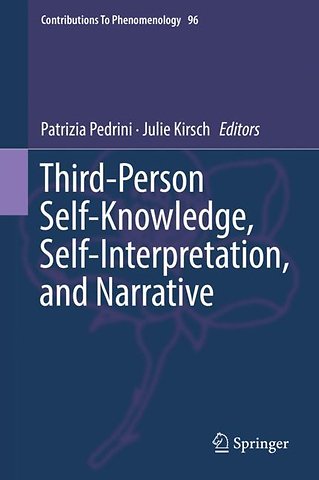
Third-Person Self-Knowledge, Self-Interpretation, and Narrative
Gebonden Engels 2018 9783319986449Samenvatting
This volume answers questions that lead to a clearer picture of third-person self- knowledge, the self-interpretation it embeds, and its narrative structure. Bringing together current research on third-person self-knowledge and self-interpretation, the book focuses on third-person self-knowledge, and the role that narrative and interpretation play in acquiring it. It regards the third-personal epistemic approach to oneself as a problem worthy of investigation in its own right, and makes clear the relation between third-person self-knowledge, self-interpretation, and narrative capacities.
In recent years, the idea that each person is in a privileged position to acquire knowledge about her own mental states has come under attack. A growing body of empirical research has cast doubt upon the existence of what philosophers call ‘first person self-knowledge’, i.e., knowledge about our mental states that is often thought to be immediate, transparent, and authoritative. Thisline of thought has led some philosophers to claim that what seems to be ‘first-person self-knowledge’ is really just ‘third-person self-knowledge,’ i.e., knowledge about our mental states that is inferential, opaque, and fallible. This book discusses challenges for first-person knowledge and explores the true nature of third-person knowledge.
Specificaties
Lezersrecensies
Inhoudsopgave
Rubrieken
- advisering
- algemeen management
- coaching en trainen
- communicatie en media
- economie
- financieel management
- inkoop en logistiek
- internet en social media
- it-management / ict
- juridisch
- leiderschap
- marketing
- mens en maatschappij
- non-profit
- ondernemen
- organisatiekunde
- personal finance
- personeelsmanagement
- persoonlijke effectiviteit
- projectmanagement
- psychologie
- reclame en verkoop
- strategisch management
- verandermanagement
- werk en loopbaan