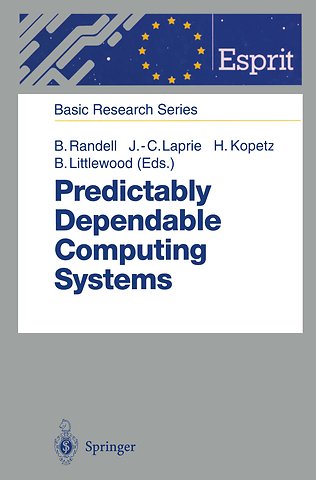
Predictably Dependable Computing Systems
Paperback Engels 2011 9783642797910Samenvatting
I. Basic Concepts.- A. Dependability — Its Attributes, Impairments and Means.- References for Chapter 1.- II. Fault Prevention.- A. Analysis of Safety Requirements for Process Control Systems.- B. Real-Time System Scheduling.- C. The Time-Triggered Approach to Real-Time System Design.- D. Software Measurement: A Necessary Scientific Basis.- References for Chapter II.- III. Fault Tolerance.- A. From Recovery Blocks to Concurrent Atomic Actions.- B. Definition and Analysis of Hardware-and-Software Fault-Tolerant Architectures.- C. Failure Mode Assumptions and Assumption Coverage.- D. Rational Design of Multiple-Redundant Systems: Adjudication and Fault Treatment.- E. Dynamic Adjustment of Dependability and Efficiency in Fault-Tolerant Software.- F. Designing Secure and Reliable Applications using FragmentationRedundancy-Scattering: an Object Oriented Approach.- G. Implementing Fault Tolerant Applications Using Reflective Object-Oriented Programming.- H. The PDCS Implementation of MARS Hardware and Software.- References for Chapter III.- IV. Fault Removal.- A. Advantages and Limits of Formal Approaches for Ultra-High Dependability.- B. Software Statistical Testing.- C. An Experimental Evaluation of Formal Testing and Statistical Testing.- D. Testing Distributed Real-Time Systems: An Overview.- References for Chapter IV.- V. Fault Forecasting — Fault Injection.- A. Integration and Comparison of Three Physical Fault Injection Techniques.- B. Fault Injection into VHDL Models: The MEFISTO Tool.- C. Estimators for Fault Tolerance Coverage Evaluation.- References for Chapter V.- VI. Fault Forecasting — Software Reliability.- A. Software Reliability Trend Analyses: From Theoretical to Practical Considerations.- B. The Transformation Approach to the Modeling and Evaluationof Reliability and Availability Growth.- C. New Ways to Get Accurate Reliability Measures.- D. Combination of Predictions Obtained from Different Software Reliability Growth Models.- E. Dependability Modelling and Evaluation of Software Fault-Tolerant Systems.- F. Dependability Analysis of Iterative Fault-Tolerant Software Considering Correlation.- G. Validation of Ultra-High Dependability for Software-based Systems.- References for Chapter VI.- VII. Fault Forecasting — Large State Space Modelling.- A. Computable Dependability Bounds for Large Markov Chains.- B. Fast Numerical Solution for a Class of Markov Models.- References for Chapter VII.- VIII. Fault Forecasting — Security Modelling.- A. Towards Operational Measures of Computer Security: Concepts.- B. Towards Operational Measures of Computer Security: Experimentation and Modelling.- References for Chapter VIII.- Pdcs Publications.
Specificaties
Lezersrecensies
Inhoudsopgave
Rubrieken
- advisering
- algemeen management
- coaching en trainen
- communicatie en media
- economie
- financieel management
- inkoop en logistiek
- internet en social media
- it-management / ict
- juridisch
- leiderschap
- marketing
- mens en maatschappij
- non-profit
- ondernemen
- organisatiekunde
- personal finance
- personeelsmanagement
- persoonlijke effectiviteit
- projectmanagement
- psychologie
- reclame en verkoop
- strategisch management
- verandermanagement
- werk en loopbaan