
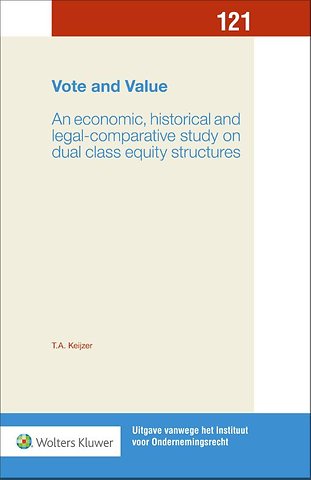

Vote and Value
An economic, historical and legal-comparative study on dual class equity structures
Gebonden Nederlands 2020 1e druk 9789013160581Samenvatting
Dual class equity structures are a hotly debated issue in corporate governance. This instrument gives certain investors more power than others. Typically – but not necessarily – such schemes involve granting superior voting shares to founders or insiders. As a result, dual class equity structures are often popular with issuers, but are mostly rejected by investors. For what firms, and under which conditions, do dual class equity structures provide an effective instrument? Vote and Value puts forward the first systematic study into the issues and recent developments concerning dual class equity structures.
Dual class equity structures
This study analyzes dual class equity structures from a financial-economic and comparative corporate governance perspective, focusing on the (legal) systems of the United States, Germany and the Netherlands. It demonstrates that dual class equity structures can be a suitable mechanism for some firms and under certain conditions. The author stresses the importance of the firm’s unique life-cycle in this regard. More specifically, dual class equity structures can be an effective instrument during shorter or longer parts of this life-cycle. The author compares the possible alternatives and provides a way forward.
Unparalleled in nuance and depth of discussion, this thought-provoking analysis deals with the corporation as a dynamic entity. It both broadens and deepens the currently available literature on the topic, which is typically limited to certain aspects of dual class equity structures in isolation.
On account of its holistic approach, this is a recommended reading for (prospective) lawyers, economists, judges and policy makers, especially those involved in corporate governance or mergers and acquisitions.
Trefwoorden
Specificaties
Lezersrecensies
Inhoudsopgave
Table of Contents – Abbreviated VII
Abbreviations XXI
Part I Introduction 1
Chapter 1. Opening 3
1.1 Setting the scene 3
1.1.1 Are stock markets becoming delusional? 3
1.1.2 Two main issues 4
1.2 Defining voting rights and profit entitlements 5
1.2.1 Introduction 5
1.2.2 Voting rights 6
1.2.3 Profit entitlements 6
1.2.4 Implications 7
1.3 Functions of dual class equity structures 8
1.3.1 Voting structures 8
1.3.2 Profit entitlement structures 9
Chapter 2. Juxtaposing the investor and the corporation 11
2.1 Introduction 11
2.2 The investor 11
2.2.1 Commitment to the investing process 11
2.2.2 Investment horizon & holding period 12
2.2.3 Amount of assets & ownership structure 14
2.2.4 Investor engagement 17
2.2.5 Shareholder homogeneity & heterogeneity 19
2.3 The corporation 21
2.3.1 Legal personality 21
2.3.2 Limited shareholder liability 23
2.3.3 Stock transferability 24
2.3.4 Board structure 25
2.3.5 Residual shareholder ownership (?) 26
Chapter 3. Methodology 29
3.1 Introduction 29
3.2 Economic analysis 29
3.2.1 Focusing on efficiency 29
3.2.2 Agency theory and control costs 31
3.3 Legal Analysis 33
3.3.1 Aiming for justice 33
3.3.2 Doctrinism: methodological rigor? 33
3.3.3 Comparative analysis 35
3.4 Historical analysis 37
Chapter 4. Scope 39
4.1 Introduction 39
4.2 Economic analysis 39
4.2.1 The function of financial markets 39
4.2.2 Capital structure and dividends 40
4.2.3 Capital structure and voting rights 40
4.3 Legal analysis 44
4.3.1 Jurisdictions 44
4.3.2 Legal entities 46
4.3.3 Topics & legal sources 47
4.4 Historical analysis 48
Chapter 5. Research questions, goals & relevance 51
5.1 Central research question & sub-questions 51
5.2 Research goals & relevance 52
5.3 Outline 53
Chapter 6. Introduction to Part II 57
Chapter 7. The functions of financial systems and the stock market 59
7.1 Introduction 59
7.2 Financial systems: risk sharing & resource allocation 59
7.3 Functions of the stock market specifically 61
7.3.1 Obtaining funding? 61
7.3.2 The stock market as exit platform 62
7.3.3 Effectiveness and implications for dual class equity structures 63
7.4 Finance versus growth 66
7.4.1 A logical connection? 66
7.4.2 Law matters? 67
7.4.3 Critiques and implications for dual class equity structures 68
Chapter 8. Capital structure and dual class equity structures 71
8.1 Introduction 71
8.2 The Modigliani-Miller irrelevance theorems 71
8.2.1 General concept 71
8.2.2 Assumptions underlying the Modigliani-Miller irrelevance theorems 72
8.2.3 The assumptions do not hold – but does it matter? 73
8.2.4 Inverting the Modigliani-Miller capital irrelevance theorems 74
8.3 Trade-off theory 75
8.3.1 General concept and implications for dual class equity structures 75
8.3.2 Critiques on trade-off theory 76
8.4 Pecking-order theory 78
8.4.1 General concept and implications for dual class equity structures 78
8.4.2 Critiques on pecking-order theory 80
8.5 Life-cycle theory: a holistic alternative 81
8.5.1 Rationale 81
8.5.2 General concept and implications for dual class equity structures 81
Chapter 9. Dividends, retained earnings and dual class equity structures 85
9.1 Introduction 85
9.2 The Modigliani-Miller dividend irrelevance theorem 85
9.2.1 General concept 85
9.2.2 Inverting the dividend irrelevance theorem 86
9.3 Taxes and clienteles 87
9.3.1 General concept 87
9.3.2 Critiques on the tax and clientele models 89
9.4 Dividend uncertainty & behavioral approaches 90
9.4.1 General concept 90
9.4.2 Critiques on uncertainty & behavioral models 94
9.5 Dividends as signals 94
9.5.1 General concept 94
9.5.2 Critiques on signaling models 95
9.6 Agency considerations of dividends 97
9.6.1 General concept 97
9.6.2 Critiques on agency models 98
9.7 Dividends as life-cycle effects 99
9.7.1 General concept and indirect evidence 99
9.7.2 Direct evidence 100
9.7.3 Implications for dual class equity structures 101
Chapter 10 Voting rights and dual class equity structures 103
10.1 Introduction 103
10.2 The costs of dual class equity structures: private benefits of control 104
10.2.1 The wedge and private benefits of control 104
10.2.2 Prevalence of dual class equity structures 105
10.3 Valuing voting rights 107
10.3.1 General observations 107
10.3.2 Variance, mitigating & aggravating factors 109
10.4 The effects of dual class equity structures 110
10.4.1 IPO underpricing 110
10.4.2 Shareholder value 111
10.4.3 Family firms 114
10.4.4 Innovation 116
10.4.5 Takeover situations 117
10.5 The benefits of dual class equity structures: idiosyncrasies 119
10.5.1 Introduction 119
10.5.2 Pacces’ view 119
10.5.3 Goshen & Hamdani’s view 121
10.5.4 Goshen & Squire’s view 122
10.6 Towards a life-cycle perspective on voting rights 123
10.6.1 General concept 123
10.6.2 The nature of the life-cycle 124
10.6.3 The life-cycle trade-off 127
10.6.4 Comparing dual class equity structures and loyalty shares 128
Chapter 11. Implications of the life-cycle approach 133
11.1 Introduction 133
11.2 Midstream recapitalizations 133
11.2.1 Voting rights 133
11.2.2 Profit entitlements 135
11.2.3 Cross-border midstream recapitalizations 135
11.3 Comparing remedies to midstream dual class equity structure recapitalizations 137
11.3.1 Majority-of-the-minority vote 137
11.3.2 Exit right 138
11.3.3 Sunset clauses 139
11.4 Index exclusion 142
11.4.1 A closer look at passive investing 142
11.4.2 Passive investing versus dual class equity structures 145
11.4.3 Indexing and life-cycle critiques 148
Chapter 12. Summary 151
12.1 The functions of financial systems and the stock market 151
12.2 Capital structure and dual class equity structures 152
12.3 Dividends, retained earnings and dual class equity structures 153
12.4 Voting rights and dual class equity structures 155
12.5 Implications of the life-cycle approach 157
Part III US Comparative Analysis 161
Chapter 13. Introduction to Part III 163
Chapter 14. The US corporate law system 165
14.1 Introduction 165
14.2 Federal versus state law 165
14.2.1 The (Dormant) Commerce Clause 165
14.2.2 First generation anti-takeover statutes 168
14.3 State corporate law 169
14.3.1 The Internal Affairs Doctrine 169
14.3.2 The rise of New Jersey 171
14.3.3 The fall of New Jersey and the rise of Delaware 174
14.3.4 Second-generation anti-takeover statutes 177
14.3.5 The future of state competition 179
14.4 Federal & state securities laws 181
14.4.1 Federal securities laws 181
14.4.2 Blue sky laws 184
14.5 Recent developments in the federal-state divide 185
14.5.1 The JOBS acts 185
14.5.2 Governance codes 187
Chapter 15. A history of US dual class equity structures 189
15.1 Introduction 189
15.2 19th Century 189
15.3 The first dual class debate: 1920s and 1930s 190
15.3.1 Banker control & stock exchange listing rules 190
15.3.2 Berle, Means & Dodd 193
15.3.3 The background of the Berle, Means & Dodd debate 194
15.4 The second dual class debate: 1980s 195
15.4.1 The causes of change 195
15.4.2 AMEX’s Wang formula and NYSE’s response 197
15.4.3 The SEC intervenes; the Business Roundtable strikes back 198
15.4.4 Stock exchange listing rules and corresponding guidance 201
15.5 The third dual class debate: 2000s – present 203
15.5.1 A repetition of moves? 203
15.5.2 The debate making progress 205
Chapter 16. Current Delaware corporate law 207
16.1 Introduction 207
16.2 The character of the corporation 207
16.2.1 Corporate purpose: traditional doctrine and current developments 207
16.2.2 Corporate personhood 211
16.2.3 Mandatory versus enabling law 213
16.3 The board 215
16.3.1 Position and composition 215
16.3.2 Fiduciary duties 217
16.3.3 Director independence & interestedness 222
16.3.4 BJR, EFS & EST 224
16.3.5 Controlling shareholder-board relationship 231
16.4 Shareholders’ right to vote & position of the AGM 233
16.4.1 General framework 233
16.4.2 Decision-making thresholds 235
16.4.3 Proxy solicitation 237
16.5 Shareholder dividend entitlements 242
16.5.1 General framework 242
16.5.2 Financial requirements & director liability 244
16.5.3 Inferior and superior dividend rights 245
Chapter 17. Dual class equity restructurings 247
17.1 Introduction 247
17.2 The pre-existing framework 247
17.2.1 An interplay of listing rules and the Delaware General Corporation Law 247
17.2.2 Williams v. Geier 250
17.3 Google: pioneering under a regulatory vacuum 251
17.4 A new judicial paradigm 253
17.4.1 Kahn v. M&F Worldwide 253
17.4.2 Dissecting the MFW-Framework 255
17.4.3 Qualifying as controlling shareholder 257
17.5 From MFW to dual class equity structure recapitalizations 260
17.5.1 Creating a dual class equity structure 260
17.5.2 Abolishing a dual class equity structure: differential consideration? 261
17.6 Analysing the MFW dual class equity restructuring framework 265
17.6.1 Enhanced doctrinal consistency 265
17.6.2 Necessity of the majority-of-the-minority vote? 266
17.6.3 Absence of an exit right? 268
Chapter 18. Summary 271
18.1 The US corporate legal landscape 271
18.2 US dual class stock from a historical perspective 272
18.3 The division of powers in Delaware corporations 274
18.4 Restructuring shareholder rights 278
Part IV German Comparative Analysis 281
Chapter 19. Introduction to Part IV 283
Chapter 20. The German corporate law system 285
20.1 Introduction 285
20.2 Federal versus state law – and beyond 285
20.3 Relevant legal entities 286
20.3.1 Partnerships 286
20.3.2 Corporations 288
20.3.3 Everything is mixed up 289
20.4 Co-determination 291
20.4.1 Societal relevance 291
20.4.2 Technical design 293
20.5 Group undertakings 294
20.5.1 Cross-holdings and banker influence 294
20.5.2 Remedial measures 296
20.6 The German corporate governance code 299
Chapter 21. A history of German dual class equity structures 303
21.1 Introduction 303
21.2 19th Century 303
21.2.1 Railroads, non-voting preference shares and the PrAktienG of 1843 303
21.2.2 Von Savigny and Von Gierke 307
21.2.3 The ADHGB of 1861 and its boom-bust progeny 308
21.2.4 The Aktienrechtsnovelle of 1884 and the Handelsgesetzbuch of 1897 312
21.3 The first dual class debate: the long 1920s 315
21.3.1 Hyperinflation in the Weimar republic 315
21.3.2 The dramatic 1930s 318
21.3.3 The views of Rathenau and Hausmann 321
21.4 The second dual class debate: the late 1990s & early 2000s 323
21.4.1 Previous minor developments 323
21.4.2 Statutory changes: the 1998 KonTraG 324
21.4.3 Private initiatives: the measures of the German stock exchange 325
21.4.4 Shifting tides in the new millennium? 327
Chapter 22. Current German corporate law 331
22.1 Introduction 331
22.2 The character of the AG 331
22.2.1 Corporate purpose 331
22.2.2 Corporate personhood 334
22.2.3 Mandatory versus enabling law 335
22.3 The executive and supervisory board 337
22.3.1 Position and composition 337
22.3.2 Fiduciary duties 341
22.3.3 Business judgement rule 343
22.3.4 Director independence & interestedness 345
22.4 Shareholders’ right to vote & position of the AGM 346
22.4.1 The concept of par value and its implications 346
22.4.2 The ban on the partitioning of shareholder rights 348
22.4.3 Shareholder voting rights 350
22.4.4 The position of the AGM 352
22.5 Shareholder dividend entitlements 354
22.5.1 General framework, financial requirements & director liability 354
22.5.2 Inferior and superior dividend rights 357
22.5.3 Non-voting preference shares: financial aspects 358
22.5.4 Non-voting preference shares: control aspects 361
Chapter 23. Dual class equity restructurings 363
23.1 Introduction 363
23.2 Creating a dual class equity structure 363
23.2.1 Issuing non-voting preference shares 363
23.2.2 The “adversely affected” criterium 365
23.2.3 Converting stock in non-voting preference shares 368
23.3 Abolishing a dual class equity structure 370
23.3.1 Non-voting preference shares 370
23.3.2 Differential consideration for non-voting preference shares 371
23.3.3 Multiple voting shares 373
23.3.4 Differential compensation for multiple voting shares under the EGAktG 375
23.3.5 Differential compensation for multiple voting shares in practice 377
23.4 Analysing the dual class restructuring framework 379
23.4.1 Non-voting preference shares: an instrument idiosyncratic toGermany 379
23.4.2 Non-voting preference shares: reactive instead of proactive 380
23.4.3 Non-voting preference shares: loopholes & absence of exit right 381
Chapter 24. Summary 383
24.1 The German corporate legal landscape 383
24.2 German dual class stock from a historical perspective 385
24.3 The division of powers in German corporations 387
24.4 Restructuring shareholder rights 390
Part V Dutch Comparative Analysis 393
Chapter 25. Introduction to Part V 395
Chapter 26. The Dutch corporate law system 397
26.1 Introduction 397
26.2 Federal versus state law: the Dutch way 397
26.3 Relevant legal entities 400
26.3.1 Open versus closed corporations 400
26.3.2 Something is mixed up 403
26.3.3 How it should be: a life-cycle perspective 404
26.4 Reasonableness & fairness 405
26.4.1 Meaning 405
26.4.2 Practical examples 408
26.5 The Dutch corporate governance code 411
Chapter 27. A history of Dutch dual class equity structures 415
27.1 Introduction 415
27.2 19th Century 415
27.2.1 The decline of the Vereenigde Oostindische Compagnie 415
27.2.2 The French period and its aftermath 418
27.2.3 Subsequent developments & legislative efforts 423
27.3 The first dual class debate: 1920s and 1930s 425
27.3.1 Effects of mandatory degressive voting 425
27.3.2 The Wetboek van Koophandel of 1928 429
27.4 The second dual class debate: 1980s and 1990s 432
27.4.1 Previous minor developments 432
27.4.2 Numerous proposals regarding non-voting shares… 433
27.4.3 … Failing to gain ground 435
Chapter 28. Current Dutch corporate law 439
28.1 Introduction 439
28.2 The character of the NV 439
28.2.1 Corporate purpose 439
28.2.2 Corporate personhood 443
28.2.3 Mandatory versus enabling law 447
28.3 The position of the executive and supervisory board 449
28.3.1 Position and composition 449
28.3.2 Director duties 451
28.3.3 Serious reproach 452
28.3.4 Director independence & interestedness 454
28.4 Shareholders right to vote & the position of the AGM 458
28.4.1 Par value, equal treatment and decision-making thresholds 458
28.4.2 Voting rights, non-voting shares & depository receipts 460
28.4.3 Loyalty shares: the DSM-case and later developments 464
28.4.4 Multiple voting shares: Altice and beyond 469
28.4.5 The position of the AGM 471
28.5 Shareholder dividend entitlements 475
28.5.1 General framework 475
28.5.2 Financial requirements & director liability 477
28.5.3 Inferior & superior profit rights 478
Chapter 29. Summary 481
29.1 The Dutch corporate legal landscape 481
29.2 Dutch dual class stock from a historical perspective 482
29.3 The division of powers in Dutch corporations 485
Chapter 30. Where do we stand? 491
30.1 Legal uncertainty 491
30.2 Regulation: the role of the legislator 492
30.3 Regulation: the role of the courts 494
Part VI Conclusion 497
Chapter 31. Summary & recommendations 499
31.1 Central research question & sub-questions 499
31.2 Conclusion 500
31.2.1 The economic perspective 500
31.2.2 The historical perspective 501
31.2.3 The legal perspective 501
31.3 Recommendations 502
31.3.1 Shareholder rights in general 502
31.3.2 Introducing a dual class equity structure in the midstream phase 504
31.3.3 Abolishing a dual class equity structure in the midstream phase 507
31.3.4 Some final thoughts 508
31.4 Recommendations specifically in relation to Dutch corporate law 509
31.4.1 Shareholder rights in general 509
31.4.2 Dual class equity structure recapitalizations 511
Nederlandse samenvatting (Dutch summary) 515
1. Centrale onderzoeksvraag en deelvragen 515
2. Conclusies 516
2.1 Het economisch perspectief 516
2.2 Het historisch perspectief 517
2.3 Het juridisch perspectief 518
3. Aanbevelingen 519
3.1 Aandeelhoudersrechten in het algemeen 519
3.2 Midstream introductie van een dual class-aandelenstructuur 520
3.3 Midstream afschaffing van een dual class-aandelenstructuur 523
4. Aanbevelingen voor het Nederlandse ondernemingsrecht 524
4.1 Aandeelhoudersrechten in het algemeen 524
4.2 Midstream introductie en afschaffing van een dual class-structuur 525
Bibliography 529
Case Law Register 635
United States 635
United States Supreme Court 635
Federal and Miscellaneous Courts 635
Delaware Supreme Court 636
Delaware Court of Chancery 638
Germany 642
Bundesverfassungsgericht (German Constitutional Court) 642
Bundesgerichtshof (German Supreme Court 1950 – present) 642
Reichsgericht (German Supreme Court 1879 – 1950) 643
Oberlandesgerichte & Kammergerichte (Courts of Appeal) 643
Landgericht (Courts of First Instance) 644
The Netherlands 644
Hoge Raad (Dutch Supreme Court) 644
Gerechtshoven (Courts of Appeal) 645
Rechtbanken (Courts of First Instance) 646
European Court of Justice 646
Parliamentary Documents 649
Germany 649
The Netherlands 649
Portfolio 651
Curriculum Vitae 657
Acknowledgements 659
Rubrieken
- advisering
- algemeen management
- coaching en trainen
- communicatie en media
- economie
- financieel management
- inkoop en logistiek
- internet en social media
- it-management / ict
- juridisch
- leiderschap
- marketing
- mens en maatschappij
- non-profit
- ondernemen
- organisatiekunde
- personal finance
- personeelsmanagement
- persoonlijke effectiviteit
- projectmanagement
- psychologie
- reclame en verkoop
- strategisch management
- verandermanagement
- werk en loopbaan
