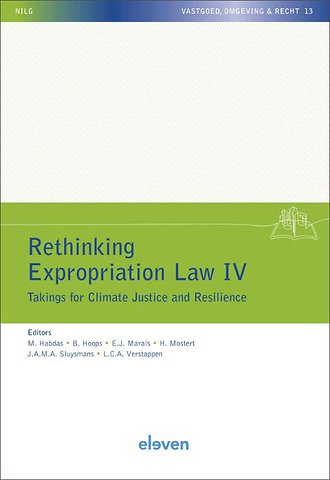

Rethinking Expropriation Law IV
Takings for Climate Justice and Resilience
Paperback Engels 2024 1e druk 9789047302100Samenvatting
The latest IPCC report makes it abundantly clear that we are failing to reach the target of limiting global warming to 1.5°C compared to the pre-industrial era. If we are to reach this target, we need to take measures to reduce the emission of greenhouse gases, to move away from fossil fuels as energy sources and to adopt renewable energy sources. Particularly high-income countries need to reduce consumption and the exploitation of nature. Enforcement is in order when incentives such as subsidies are not sufficiently effective.
To explore and reflect on the scope for state action that limits or expropriates property for climate protection, we gathered a group of scholars from around the world at the 2022 conference 'Takings for Climate Justice and Resilience', hosted by the University of Groningen. We sought to address the scope for States to expropriate property for renewable energy projects, to prohibit harmful activities on land, and to compel owners to refurbish their buildings. This fourth book in the Rethinking Expropriation Law series of the Expert Group on Expropriation Law (www.expropriation.info) contains fourteen double-blind peer-reviewed contributions based upon presentations given at the aforementioned conference. This book aims to contribute to the legal debate on how to better protect our climate, intended for academics, practitioners, policymakers and politicians.
The series Vastgoed, Omgeving & Recht (Property, Environment & Law) focuses on exchange of knowledge and discussion between theory and practice in the field of real estate, environment and law in the broadest sense. Monographs, theses, conference bundles and comments are part of the series. This series is part of the book series published by the Nederlands Institute for Law and Governance (NILG).
The Nederlands Institute for Law and Governance (NILG) is a joint venture between the faculties of law at the VU University Amsterdam, the University of Groningen and other research institutions to improve research in the field of Law and Governance. The NILG’s research theme is the interaction between the regulation of public and private interests in law and the way in which these interests are being regulated.
Specificaties
Lezersrecensies
Inhoudsopgave
M. Habdas, B. Hoops, E.J. Marais, H. Mostert, J.A.M.A. Sluysmans and L.C.A.
Verstappen
2 Takings for Climate in Germany 7
Thomas Lundmark and Sebastian Herrmann
2.1 Introduction 7
2.2 The Scope of Protection of Article 14 10
2.2.1 Article 14 as a Weak Defense Against Governmental Climate Protection Measures 10
2.2.2 Compensation Awarded in Only Exceptional Circumstances 12
2.2.3 The Broad, Statute-Influenced, and “Climate-Driven” Constitutional Concept of Ownership 13
2.2.4 Climate Protection Interventions in Property 18
2.3 The Distinction Between Restrictions of Property and Expropriation 19
2.3.1 The Special-Sacrifice Test of the Federal Court of Justice 21
2.3.2 The Test of Magnitude of the Federal Administrative Court 24
2.3.3 Situational Test 25
2.3.4 Separation Model or “Narrow” Concept of Expropriation 27
2.3.4.1 Marginalization of the Expropriation 28
2.3.4.2 Compensatory restrictions of property 29
2.3.4.3 Separation model and climate protection law 31
2.3.4.4 Advantages of the separation model for climate legislators and property owners 32
2.4 The Constitutionality of Restrictions of Property 33
2.4.1 Conflicting Constitutional Interests in Climate Protection 34
2.4.2 Proportionality of Property-Relevant Restrictions of Property in Climate Change Law 35
2.5 Conclusion 42
3 Property Rights, Regulation, and Expropriation for Renewable
Energy in Norway 45
Børge Aadland and Sjur K. Dyrkolbotn
3.1 Introduction 45
3.2 Hydropower 46
3.2.1 Property Regime 48
3.2.2 Regulatory Regime 53
3.2.3 Expropriation 56
3.3 Wind Power 58
3.3.1 Property Regime 59
3.3.2 Regulatory Regime 61
3.3.3 Expropriation 64
3.4 Solar Power 66
3.4.1 Property Regime 67
3.4.2 Regulatory Regime 68
3.4.3 Expropriation 70
3.5 Geothermal Heat 72
3.5.1 Property Regime 73
3.5.2 Regulatory Regime 75
3.5.3 Expropriation 77
3.6 Discussion and Conclusion 79
4 Combatting the Climate and Electricity Crisis in South Africa 85
Private Property Rights and the Establishment of Renewable Energy Plants
Tina Gama-Kotzé
4.1 Introduction 85
4.2 South Africa’s Energy Composition and Legal Framework: Moving Towards Renewable Energy 90
4.2.1 Background: South Africa’s Current Energy Composition and Energy Crisis 90
4.2.2 The (Renewable) Energy Legal Framework: The REIPPP Programme 95
4.3 Reconciling Constitutional Rights: Regulating or Expropriating Land for Renewable Energy 99
4.3.1 Introduction 99
4.3.2 Deprivation of Property in the Energy Context: Renewable Energy Development Zones 103
4.3.2.1 Defining Deprivation of Property 103
4.3.2.2 Arbitrary Deprivation of Property 105
The Establishment of Renewable Energy Development Zones 110
4.3.3 Expropriation of Land for the Establishment of Renewable Energy Plants 115
4.3.3.1 Defining Expropriation of Property 115
4.3.3.2 Expropriation of Land under the REIPPPP 116
4.4 Combatting the Climate and Electricity Crisis: Developing Legislative Measures to Accelerate the Move Towards Renewable Energy in South Africa 119
4.5 Conclusion 122
5 The Framing of Climate Change Discourse and Policy 125
Resilience and Vulnerability in Romanian Wave of Building Renovation
Dana Georgeta Alexandru and Cristina Oneț
5.1 Introduction 125
5.2 Property Rights and Climate Justice: An Interaction 127
5.3 Transforming the Property Rights Under the Pressure of Climate Change 129
5.4 Climate Change Coping Strategy 133
5.4.1 Legal Framework and Problem Definition 135
5.4.2 Budgetary Implications of the Obligation to Renovate Residential Buildings 139
5.5 Conclusions 142
6 Rethinking Expropriation to Establish Protected Areas in Community Lands in East and Central Africa 145
Liz Alden Wily
6.1 Introduction 145
6.2 Context 146
6.2.1 The Importance of Africa Halting Resource Degradation 146
6.2.2 The Status of Forests and Rangelands 147
6.2.3 Communities and Community Lands 148
6.2.4 Community Land Security 149
6.2.5 The Troubled Interface Between Public and Community Lands 152
6.3 Discussion 152
6.3.1 How Real Are the Proffered Protections of Community Lands in the CBF? 152
6.3.2 Where Do Community Representatives Stand on 30 X 30? 156
6.3.3 Does Community Conservation Reduce Biodiversity Losses? 158
6.3.4 Where Do Governments Stand in Enabling Communities to Own and Manage Protected Areas? 159
6.3.4.1 East Africa 160
6.3.4.2 Central Africa 161
6.3.4.3 A Basis for Expanding Community Forests Exists 163
6.3.4.4 Community Forest Conservation May Not Be Working as Successfully as Intended 164
6.3.5 Is More Benefit Sharing the Answer? 166
6.3.6 Can improved compensation at expropriation for new TPA mitigate community concerns? 168
6.3.6.1 East Africa 169
6.3.6.2 Central Africa 173
6.4 Conclusion 176
6.4.1 Conclusion 1 176
6.4.2 Conclusion 2 177
6.4.3 Conclusion 3 179
6.4.4 Conclusion 4 180
6.4.5 Conclusion 5 181
6.4.6 Conclusion 6 181
7 Facilitating Climate-Friendly Improvements in Condominiums 183
Recent Developments in Spanish and Catalan Law
Miriam Anderson
7.1 Introduction 183
7.2 The Implementation of the EU Provisions on Renewable Energy and Energy Efficiency in Spain 185
7.3 The Spanish and Catalan Legal Model for Multi-Unit Buildings 189
7.4 The Majority Required to Undertake Energy-Efficiency Improvements 192
7.4.1 Spain 192
7.4.2 Catalonia 196
7.5 Ramifications of Energy-Renovation Works in Multi-Unit Buildings 200
7.6 Unsecured Loans and Public Guarantees 203
7.7 The Limited Role of Tax Reductions 206
7.8 Concluding Remarks 208
8 Climate Change and the Social Function of Property 213
A Human Flourishing Reading of Article 1 of Protocol No 1 to the European Convention on Human Rights
Víðir Smári Petersen
8.1 Introduction 213
8.2 The Three Rules and the Role of Compensation 216
8.2.1 Compensation for Deprivations 218
8.2.2 The Other Two Rules 222
8.3 Outlining the Theory of Human Flourishing 223
8.3.1 The Core Elements of Human Flourishing 225
8.3.2 Human Flourishing as a Pluralist Theory 227
8.4 The Social Obligation, Climate Change and Land-Use 228
8.4.1 How Important Is the Social Issue at Stake? 229
8.4.2 Will Inaction on Behalf of the State Hurt Future Generations? 230
8.4.3 How Intrusive Is the Interference Towards the Owner? 231
8.4.4 The Owner’s Status? 231
8.4.5 Is the State’s Interference Directed Against the Owner’s Property for a Particular Reason? 232
8.5 Does Social Obligation Fit With The ECtHR’s Case-Law? 234
8.5.1 The Social Function – A Social Obligation? 234
8.5.2 The Importance of the Social Issue 236
8.5.3 How Intrusive Is the Government’s Action? 237
8.5.4 The Status of the Owner 238
8.5.5 Intergenerational Equity 239
8.5.6 Harmful Use and the States’ Positive Obligations 240
8.5.7 The Question of Compensation – Deprivation 242
8.5.8 The Question of Compensation – The Other Two Rules 243
8.6 Conclusions 245
9 The Procedural Turn, the Right to Property and Climate Change
Expropriation: Quo Vadis? 247
Ignatius Yordan Nugraha and Harriet Ní Chinnéide
9.1 Introduction 247
9.2 The Procedural Turn, Expropriation and the Right to Property 249
9.2.1 Defining the Procedural Turn 249
9.2.2 Procedural Turn in Cases Concerning Expropriation? 254
9.3 Substantive Standards on Expropriation 256
9.4 Procedural Turn and Climate Change Expropriation 259
9.4.1 Mitigation of Climate Change as a Pre-Eminent Interest 259
9.4.2 Procedural Turn and Climate Change Expropriation 261
9.4.3 Comparison with a Purely Substantive Review 264
9.5 Conclusion 265
10 Making Scottish Apartment Law Sustainable 269
An A1P1 Analysis
Frankie McCarthy
10.1 Introduction 269
10.2 Background to the Project – Sustainability Policy and Tenement Law 270
10.2.1 Policy Background 270
10.2.2 Improving the Sustainability of Tenement Buildings 271
10.2.3 Tenement Law 272
10.2.4 Scottish Parliamentary Working Group on Tenement Maintenance 275
10.2.5 Scottish Law Commission Project 278
10.3 Constitutional Property Protection in Scotland 279
10.3.1 The Human Rights Framework in Scotland and the UK 279
10.3.2 The Judicial Framework for Determination of A1P1 Applications in Strasbourg and the UK 281
10.4 A1P1 and the introduction of tenement owners’ associations 283
10.4.1 A1P1 Engaged 283
10.4.2 Categorising the Interference: The “Three Rules” 285
10.4.3 Can the Interference Be Justified? 289
10.5 Conclusion 292
11 The Positive Obligation to Renovate 293
Towards Social Responsibility for Owners?
Dorothy Gruyaert
11.1 Introduction 293
11.2 The Flemish Obligation to Renovate 294
11.2.1 The Flemish Renovation Obligation for Non-residential Buildings 294
11.2.2 The Flemish Renovation Obligation for Residential Buildings 296
11.2.3 Background 297
11.2.3.1 European energy efficiency measures transforming the building stock 297
11.2.3.2 Towards mandatory minimum energy performance standards (MEPs) 300
11.3 The Change in Ownership Regulations: An Owner’s Social Responsibility 302
11.3.1 The Socialization of the Right of Ownership 302
11.3.2 From Negative to Positive Ownership Obligations 304
11.3.2.1 Prohibitions for Owners to Act in an Abusive, Unreasonable Manner 304
11.3.2.2 Obligations for owners to act socially and/or ecologically 305
11.3.3 How (Socially) Sustainable Is the Renovation Obligation? 307
11.4 Concluding Remarks 308
12 Enabling Resilient Property Systems 309
Existing Legal Opportunities and Challenges
Rachael Walsh
12.1 Introduction 309
12.2 Relating Resilience and Sustainability 312
12.3 Surveying the Public Law Landscape for Resilient Property Regulation 313
12.4 Hypothesising the Limits of Resilience as a Delimiting Principle 317
12.5 Conclusions 322
13 Takings in Extraordinary Circumstances 325
Confession of a Consumer
Leon Verstappen
13.1 Introduction 325
13.2 The Problem 326
13.3 We and Our Behaviour 328
13.4 Property Law 332
13.5 Human Obligations and Responsibilities; Solidarity 333
13.6 Sustainability Regulations 334
13.7 Obligation of the State to Reduce Greenhouse Gases 338
13.8 Infringement of Property and Expropriation 341
13.9 Expropriation 345
13.9.1 Expropriation Interest 347
13.9.2 Necessity 348
13.9.3 Urgency 348
13.9.4 Procedure 348
13.9.5 Alternative Measures 350
13.10 Emergency Law 351
13.10.1 Written and Unwritten Emergency Law, Institution and Form Free Emergency Law 354
13.10.2 Unwritten Emergency 355
13.10.3 Extraordinary Circumstance, Extraordinary Power and Extraordinary Legal Situation 355
13.10.4 Extraordinary Circumstance 356
13.10.5 Extraordinary Power 359
13.10.6 Extraordinary Legal Situation – State of Exception 359
13.11 Questions to Be Answered Prior to Applying Emergency Law 361
13.12 Emergency Law and Expropriation 364
13.13 Conclusion 368
14 Losing or Exiting Negatively Valued Ownership in a Climate-Distressed World 371
The Options in South Africa
Richard Cramer and Hanri Mostert
14.1 Introduction 371
14.2 Negative-Value Property 374
14.2.1 Climate Change as a Cause of Negative Value 377
14.2.2 The Duty to Maintain 382
14.3 Allocation of Burdens 384
14.3.1 The “Social” Obligation 384
14.3.2 The Duty on the State 387
14.3.2.1 Disaster Management Act (DMA) 389
14.3.2.2 Climate Change Bill 390
14.4 Exit from Ownership 392
14.4.1 Possibility of Expropriation/Compulsory Acquisition 393
14.4.2 Possibility of Abandonment 397
14.5 Conclusion 400
15 Expropriation’s Afterlives 403
Abandoned Infrastructure, Toxic Ruins, and the Public Interest
Julie L. Hassman
15.1 Introduction 403
15.2 Thinking with the Ruins 407
15.2.1 The Infrastructural Ruins of the Hydrocarbon Age 408
15.2.2 Expropriation Law and the Infrastructural Ruins 414
15.3 The Future Present – A Case Study of The East African Crude Oil Pipeline 418
15.3.1 Context & Background 419
15.3.2 Situating the Pipeline 420
15.3.3 Land Expropriation in the Context of EACOP 424
15.3.3.1 The International Finance Corporation (IFC) Performance Standards 425
15.3.3.2 The Voluntary Guidelines on the Responsible Governance of Tenure of Land, Fisheries, and Forests 427
15.3.3.3 Analysis of International Expropriation Guidelines in the EACOP Context 428
15.4 Moving Toward an Ethic of Repair and Care 433
15.4.1 Relationality 435
15.4.2 Plurality/Pluriversality 437
15.5 Conclusion 439
Previously Published in the Vastgoed, Omgeving & Recht Series 441
Anderen kochten ook
 Chris Backes€ 90,50
 Michael Mehling€ 281,67
 Margaretha Wewerinke-Singh€ 49,50
 Jaap Spier€ 107,95
 Jacco Karens€ 67,–
 Heleen Dekker€ 19,95
Rubrieken
- advisering
- algemeen management
- coaching en trainen
- communicatie en media
- economie
- financieel management
- inkoop en logistiek
- internet en social media
- it-management / ict
- juridisch
- leiderschap
- marketing
- mens en maatschappij
- non-profit
- ondernemen
- organisatiekunde
- personal finance
- personeelsmanagement
- persoonlijke effectiviteit
- projectmanagement
- psychologie
- reclame en verkoop
- strategisch management
- verandermanagement
- werk en loopbaan