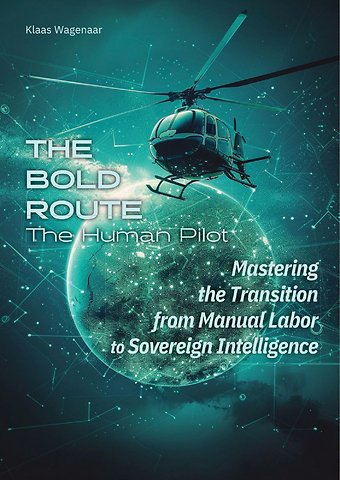
The Bold Route: The Human Pilot
Mastering the Transition from Manual Labor to Sovereign Intelligence
Paperback EN 2026 1e druk 9789083678900Samenvatting
The Big Idea
The trilogy is a comprehensive "flight manual" for C-suite leaders navigating the AI revolution, written by a veteran CEO and turnaround expert who is also a licensed IFR twin-engine pilot. That aviation background isn't just decorative — it provides the trilogy's central metaphor and moral framework throughout: the leader as Pilot in Command, always responsible, never a passenger.
The overarching argument across all three books is captured in one line Wagenaar repeats like a mantra: "The AI revolution is not the end of the pilot; it is the end of the passenger."
The Three Books as a Journey
The trilogy moves deliberately from the human to the operational to the strategic:
Book I — The Human Pilot asks Why and What. It addresses the psychological and leadership challenge: how do you inspire people to leave the comfort of "steady-state" management when they don't yet see the fire? It introduces the "Rotary Mindset" — embracing conscious instability, operating in the 200-foot margin where others are paralysed, and transforming a workforce from fearful "turkeys" into Agentic Architects. The enemy here is inertia and fear.
Book II — The Agentic Architect asks How. It provides the operational and structural blueprint for professional services firms (Audit, Tax, Advisory) to make the transition. The central concept is the "Great Decoupling" — breaking the link between billable human hours and revenue — and replacing it with orchestrated AI agent swarms. It introduces the Agentic Index maturity model, vertical playbooks for specific industries, and the role of the Systems Guardian. The enemy here is the billable-hour model and the Efficiency Trap.
Book III — The Sovereign Synthesis asks What next — and what threatens it all? It zooms out to the biggest strategic horizon: the looming loss of organisational sovereignty to Big Tech platforms, and the approaching disruption of quantum computing. It warns that winning the AI transition means nothing if you've handed your data, your infrastructure, and your AI intent to external "creditors." The enemy here is Digital Receivership and dependency.
The Connecting Thread
Three concepts run through all three volumes like a spine:
• The Human Premium — As AI handles execution, the irreplaceable human contribution becomes strategic judgment, empathy, ethical oversight, and what Wagenaar calls "Strategic Taste." This is not threatened by AI; it is elevated by it.
• The Pilot's Veto — No matter how autonomous the system, the human leader retains final moral and strategic authority. This is non-negotiable across all three books.
• Sovereign Intelligence — The endgame is not dependence on external AI empires, but building private, fine-tuned intelligence within your own "Data Fortress" — organisations that orchestrate AI rather than being orchestrated by it.
Audience & Style
The trilogy is aimed squarely at Managing Partners, CEOs, and CXOs — particularly in professional services — who are wrestling with AI disruption at a strategic level. The tone is part boardroom briefing, part war memoir: Wagenaar draws heavily on his own turnaround experiences at Getronics, KPMG, and CapGemini, and each chapter ends with practical "Mission Readiness Checklists." All three books were co-written with Google's Gemini AI — itself a live demonstration of the human-AI collaboration the trilogy advocates.
In a single sentence: The BOLD Route Trilogy is a call to arms for leaders to stop being passengers in the AI era — to master the human side of transformation, build AI-first organisations, and fiercely protect their sovereignty before the quantum era renders today's advantages obsolete.
Here's a summary of The BOLD Route: The Human Pilot by Klaas Wagenaar (2026):
Overview
This is the first volume in Wagenaar's BOLD Route Trilogy — a CEO-focused "flight manual" for leading organisations through the AI revolution. Where The Agentic Architect (the second book) focuses on the mechanics of building AI-first firms, The Human Pilot addresses the leadership psychology and human dimension of that transformation: how to inspire people, manage fear, and exercise judgment when AI changes everything.
Central Metaphor
Wagenaar draws extensively on his experience as a licensed helicopter and fixed-wing pilot. The core metaphor: traditional "steady-state" management is like flying a fixed-wing aircraft — engineered for stability and clear skies. But the AI era demands rotary (helicopter) leadership — inherently unstable, requiring constant micro-adjustments, capable of hovering, pivoting, and taking off vertically. The leader who tries to fly through this era with old aerodynamic rules will stall.
Key Themes
• Conscious Instability — Stability is no longer safe. Leaders must embrace the "200-foot margin" (where helicopters can fly but fixed-wing aircraft can't) as the space where competitive advantage lives. Constant micro-adjustment is the new normal.
• The Invisible Burning Platform — Don't wait for a visible crisis to force change. The AI disruption is already underway even when the metrics look fine. Wagenaar draws on his own turnaround experience at Getronics — including a secret overnight sale of subsidiary Raet that cleared €500 million in debt — to illustrate proactive, high-precision manoeuvres before the engine fails.
• The Pilot's Veto — The CEO must retain ultimate moral and strategic authority. AI handles velocity and data; the human leader remains "Human-on-the-Loop" — the final safeguard against ethical drift and "black box" logic.
• No More "Turkeys for Christmas" — Employees fear AI will make them redundant. The leader's job is to transform that fear: people don't lose their jobs, they gain a fleet of AI agents. The worker evolves from doing tasks to designing the agents that do tasks — becoming an Agentic Architect.
• The 1 + 1 = 3 Dividend — Human wisdom combined with AI velocity doesn't just improve performance; it changes the nature of what's possible. This "agentic dividend" is the business case for transformation.
• Navigating for the Greater Good — AI-first transformation is a moral commitment, not just a commercial one. All stakeholders — employees, shareholders, clients — must be brought along. Wagenaar references Freeman's Stakeholder Theory and the Johnson & Johnson Tylenol recall as models of principled, decisive leadership.
Structure
The book is organised in five phases: The Why (the leap of faith), The What (rotary aerodynamics of leadership), The How (setting the flight deck), Advanced Manoeuvres (ethics, guardrails, the first 100 days), and Safe Harbour. Each chapter ends with a practical "Mission Readiness Checklist."
Tone & Audience
Written directly for C-suite leaders and Managing Partners, it's more personal and narrative-driven than a typical business book — rich with Wagenaar's own war stories from corporate turnarounds at Getronics, KPMG, and CapGemini. Like its companion volume, it was co-written with Google's Gemini AI, which Wagenaar frames as practising what it preaches.
In short, this is a leadership book about the human side of the AI transition — how CEOs can inspire courage over fear, retain moral authority in an automated world, and turn their people into architects rather than casualties of the AI era.
Specificaties
Lezersrecensies
Rubrieken
- advisering
- algemeen management
- coaching en trainen
- communicatie en media
- economie
- financieel management
- inkoop en logistiek
- internet en social media
- it-management / ict
- juridisch
- leiderschap
- marketing
- mens en maatschappij
- non-profit
- ondernemen
- organisatiekunde
- personal finance
- personeelsmanagement
- persoonlijke effectiviteit
- projectmanagement
- psychologie
- reclame en verkoop
- strategisch management
- verandermanagement
- werk en loopbaan