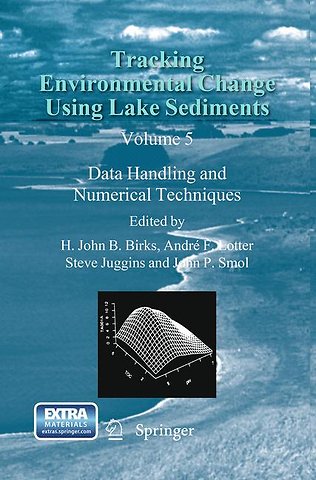
H. John B. Birks,
André F. Lotter,
Steve Juggins,
John P. Smol
e.a.
Tracking Environmental Change Using Lake Sediments
Data Handling and Numerical Techniques
Paperback Engels 2016 9789401779197Levertijd ongeveer 9 werkdagen
Gratis verzonden
Samenvatting
Numerical and statistical methods have rapidly become part of a palaeolimnologist’s tool-kit. They are used to explore and summarise complex data, reconstruct past environmental variables from fossil assemblages, and test competing hypotheses about the causes of observed changes in lake biota through history. This book brings together a wide array of numerical and statistical techniques currently available for use in palaeolimnology and other branches of palaeoecology.
Visit http://extras.springer.com the Springer's Extras website to view data-sets, figures, software, and R scripts used or mentioned in this book.
Specificaties
ISBN13:9789401779197
Taal:Engels
Bindwijze:paperback
Uitgever:Springer Netherlands
Lezersrecensies
Wees de eerste die een lezersrecensie schrijft!
Inhoudsopgave
Part I: Introduction, Numerical Overview, and Data-Sets.
1. The march towards the quantitative analysis of palaeolimnological data
2. Overview of numerical methods in palaeolimnology
3. Data-sets
Part II: Numerical Methods for the Analysis of Modern and Stratigraphical Palaeolimnological Data
4. Introduction and overview of Part II
5. Exploratory data analysis and data display
6. Assessment of uncertainties associated with palaeolimnological laboratory methods and microfossil analysis
7. Clustering and partitioning
8. From classical to canonical ordination
9. Statistical learning in palaeolimnology
Part III: Numerical Methods for the Analysis of Stratigraphical Palaeolimnological Data
10. Introduction and overview of Part III
11. Analysis of stratigraphical data
12. Estimation of age-depth relationships
13. Core correlation
14. Quantitative environmental reconstructions from biological data 15. Analogue methods in palaeolimnology
16. Autocorrelogram and periodogram analyses of palaeolimnological temporal-series from lakes in central and western North America to assess shifts in drought conditions
Part IV: Case Studies and Future Developments in Quantitative Palaeolimnology
17. Introduction and overview of Part IV
18. Limnological responses to environmental changes at inter-annual to decadal time scales
19.Human impacts – applications of numerical methods to evaluate surface-water acidification and eutrophication
20.Tracking Holocene climatic change with aquatic biota from lake sediments: case studies of commonly used numerical techniques
21. Conclusions and future challenges.- Glossary, acronyms, and abbreviations
Index
1. The march towards the quantitative analysis of palaeolimnological data
2. Overview of numerical methods in palaeolimnology
3. Data-sets
Part II: Numerical Methods for the Analysis of Modern and Stratigraphical Palaeolimnological Data
4. Introduction and overview of Part II
5. Exploratory data analysis and data display
6. Assessment of uncertainties associated with palaeolimnological laboratory methods and microfossil analysis
7. Clustering and partitioning
8. From classical to canonical ordination
9. Statistical learning in palaeolimnology
Part III: Numerical Methods for the Analysis of Stratigraphical Palaeolimnological Data
10. Introduction and overview of Part III
11. Analysis of stratigraphical data
12. Estimation of age-depth relationships
13. Core correlation
14. Quantitative environmental reconstructions from biological data 15. Analogue methods in palaeolimnology
16. Autocorrelogram and periodogram analyses of palaeolimnological temporal-series from lakes in central and western North America to assess shifts in drought conditions
Part IV: Case Studies and Future Developments in Quantitative Palaeolimnology
17. Introduction and overview of Part IV
18. Limnological responses to environmental changes at inter-annual to decadal time scales
19.Human impacts – applications of numerical methods to evaluate surface-water acidification and eutrophication
20.Tracking Holocene climatic change with aquatic biota from lake sediments: case studies of commonly used numerical techniques
21. Conclusions and future challenges.- Glossary, acronyms, and abbreviations
Index
Rubrieken
- advisering
- algemeen management
- coaching en trainen
- communicatie en media
- economie
- financieel management
- inkoop en logistiek
- internet en social media
- it-management / ict
- juridisch
- leiderschap
- marketing
- mens en maatschappij
- non-profit
- ondernemen
- organisatiekunde
- personal finance
- personeelsmanagement
- persoonlijke effectiviteit
- projectmanagement
- psychologie
- reclame en verkoop
- strategisch management
- verandermanagement
- werk en loopbaan