,

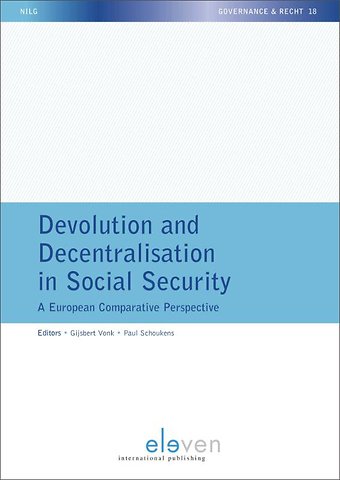
Devolution and Decentralisation in Social Security

A European Comparative Perspective

Paperback Engels 2019 1e druk 9789462369801
€ 115,95
Nu besteld, woensdag in huis
Gratis verzonden

Samenvatting

In many countries regional and local authorities are given more powers in the field of social security. Supposedly, this is a general trend taking place throughout the developed world and beyond.

In this volume the processes of devolution and decentralisation in social security are researched from a comparative European perspective, taking into account the constitutional setting and the architecture of the social security systems. The book includes thirteen country studies based on a uniform format and three overarching contributions.

The greater picture that emerges is that social insurance and family allowances are still very much a national competence and are predominantly functionally decentralised to a number of specialised agencies and institutions. There are only limited exceptions. A different conclusion must be drawn when we look at social assistance and social care. In many countries the role of local authorities has gradually increased over a longer period. However, in some countries this trend is reversing, and municipal powers are being limited or even taken back by central government.

Devolution and Decentralisation in Social Security shows how complex, differentiated and nationally diverse the state of devolution and decentralisation in Europe actually is. This book is of particular interest to scholars in the field of social policy and social security, constitutionalists and policy makers who are interested in local administration.

The series Governance & Recht is aimed at the general debate concerning governance in relation to law. The series provides a platform for contributions to this debate in the fields of positive law, comparative law, legal theory, philosophy of law, sociology of law, political science and public administration. This series is part of the book series published by the Netherlands Institute for Law and Governance (NILG).

The Netherlands Institute for Law and Governance (NILG) is a joint venture between the faculties of law at the VU University Amsterdam, the University of Groningen and other research institutions to improve research in the field of Law and Governance. The NILG’s research theme is the interaction between the regulation of public and private interests in law and the way in which these interests are being regulated.
Lezersrecensies

Wees de eerste die een lezersrecensie schrijft!

Over Gijsbert Vonk

Prof. Dr. G.J. Vonk is hoogleraar socialezekerheidsrecht aan de Rijksuniversiteit Groningen en bijzonder hoogleraar socialezekerheidsrecht aan de Vrije Universiteit. Hij is in 1991 gepromoveerd in Tilburg op een proefschrift over de coördinatie van bestaansminimumuitkeringen in de Europese Gemeenschap. Zijn specialismen liggen op het terrein van (internationaal) socialezekerheidsrecht, Europees recht en bestuursrecht.

Andere boeken door Gijsbert Vonk

Inhoudsopgave

Table of Contents

Part I General background 11
The state of devolution and decentralisation in social security, a comparative European analysis: an introduction to this edited volume 13
Paul Schoukens & Gijsbert Vonk

1 Introduction 13
2 Setup and method of the research 15
3 Some reflections on the outcome of the country studies 19
4 Further research agenda: challenges for the local welfare state 21
Federalism and devolution in social security 25
Danny Pieters

1 Federalism, decentralisation and ‘deconcentration’ 25
2 Social security competences 28
3 Distribution of social security competences in a number of federal states 30
Sharing power with employers and employees: a tried and proven form of functional decentralisation in Europe 41
Ulrich Becker

1 Introduction 41
2 Social self-government as a specific form of functional decentralisation: features and appearances 42
3 On the functioning of social self-government: the case of Germany 48
4 Final observations: weaknesses and strengths of social selfgovernment 53

Part II Country reports 55
Devolution and decentralisation in social security: the situation in Austria 57
Verena Zwinger
1 A general picture of the social security system and the administrative structure 57
2 The state of devolution 58
3 The state of decentralisation 62
4 The state of the debate and future perspectives 71
Devolution and decentralisation in social security: the situation in Belgium 73
Jessie De Weyer & Paul Schoukens

1 Belgium 73
2 Social security 78
3 Division of competences in the field of social security 82
4 Social assistance at the local level (territorial decentralisation) 85
5 Regional social security under development 86
6 The state of the debate and future perspectives 89
Devolution and decentralisation in social security: the situation in the Czech Republic 93
Jakub Tomšej

1 A general picture of the social security system and administrative structure 93
2 The state of devolution 95
3 The state of decentralisation 99
4 The state of the debate and future perspectives 105
Devolution and decentralisation in social security: the situation in Germany 107
Stephan Rixen

1 A general picture of the system of social security and the administrative organisation 107
2 The state of devolution 109
3 The state of decentralisation 114
4 The state of the debate and future perspectives 121
8 Devolution and Decentralisation in Social Security
Devolution and decentralisation in social security: the situation in Hungary 123
Gábor Juhász

1 A general picture of the social security system and its administrative structure 123
2 The state of devolution 124
Afgekapt op 60 regels

Managementboek Top 100

€ 115,95
Woensdag in huis
Gratis verzonden

Rubrieken

Producten

    Auteurs

      Trefwoorden

        Artikelen

          Devolution and Decentralisation in Social Security