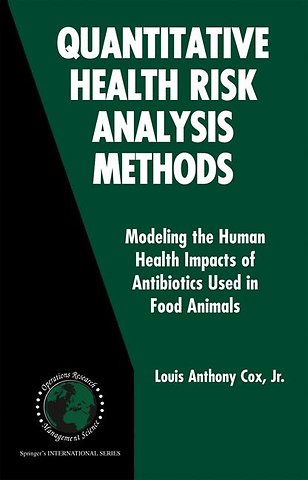
Quantitative Health Risk Analysis Methods
Modeling the Human Health Impacts of Antibiotics Used in Food Animals
Gebonden Engels 2005 2006e druk 9780387259093Samenvatting
This book grew out of an effort to salvage a potentially useful idea for greatly simplifying traditional quantitative risk assessments of the human health consequences of using antibiotics in food animals. In 2001, the United States FDA’s Center for Veterinary Medicine (CVM) (FDA-CVM, 2001) published a risk assessment model for potential adverse human health consequences of using a certain class of antibiotics, fluoroquinolones, to treat flocks of chickens with fatal respiratory disease caused by infectious bacteria. CVM’s concern was that fluoroquinolones are also used in human medicine, raising the possibility that fluoroquinolone-resistant strains of bacteria selected by use of fluoroquinolones in chickens might infect humans and then prove resistant to treatment with human medicines in the same class of antibiotics, such as ciprofloxacin. As a foundation for its risk assessment model, CVM proposed a dramatically simple approach that skipped many of the steps in traditional risk assessment. The basic idea was to assume that human health risks were directly proportional to some suitably defined exposure metric. In symbols: Risk = K × Exposure, where “Exposure” would be defined in terms of a metric such as total production of chicken contaminated with fluoroquinolone-resistant bacteria that might cause human illnesses, and “Risk” would describe the expected number of cases per year of human illness due to fluoroquinolone-resistant bacterial infections caused by chicken and treated with fluoroquinolones.
Specificaties
Lezersrecensies
Rubrieken
- advisering
- algemeen management
- coaching en trainen
- communicatie en media
- economie
- financieel management
- inkoop en logistiek
- internet en social media
- it-management / ict
- juridisch
- leiderschap
- marketing
- mens en maatschappij
- non-profit
- ondernemen
- organisatiekunde
- personal finance
- personeelsmanagement
- persoonlijke effectiviteit
- projectmanagement
- psychologie
- reclame en verkoop
- strategisch management
- verandermanagement
- werk en loopbaan