Dr ir Bert Slagmolen (1952) is sinds 1978 actief als adviseur en onderzoeker. Organisatieontwikkeling is vanaf het prille begin het centrale thema in zijn professionele leven.
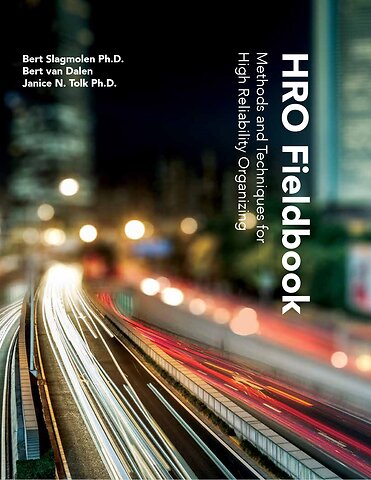
Meer over de auteursHRO Fieldbook
Methods and techniques for high reliability organizing
Gebonden Engels 2017 1e druk 9789081820110Samenvatting
Every organization faces challenges regarding their performance. Making services more reliable, producing goods more safely, or staying healthy in hostile environments. Due to rapidly changing dynamics in society and technology many people in organizations and networks experience more volatility, uncertainty, complexity and ambiguity (or VUCA). Next to better procedures and more robust processes organizations need to invest in collective alertness and resilience to manage the unexpected. They need to stay active and keep asking questions in this VUCA context.
High reliability organizing (HRO) represents a body of knowledge gained by organization that keep their performance on a very high level despite external dynamics and internal complexity. This body is coded by Karl Weick and Kathleen Sutcliffe in their seminal book Managing the unexpected. Our HRO Fieldbook builds on this body of knowledge and on the practical experience of many practitioners applying HRO concepts and methods. We offer more than 95 methods and techniques to make HRO work.
I have worked with the professionals of Apollo13 consult, in challenging situations, and have confidence in their knowledge, experience , capabilities and desires to enhance organizational resilience, reliability and performance. They know that there are no ready-made answer to the challenges managers and professionals are facing in this dynamic and complex world . Their work is rare and unique.
Specificaties
Lezersrecensies
Over Bert van Dalen
Over Janice Tolk
Inhoudsopgave
1 THE TEMPTATION OF MORE RULES 13
1.1 Perform in a Dynamic World 13
1.2 Prevention Takes Priority when We Organize 14
1.3 Resilience and Alertness in Organizing 16
2 THE CAPABILITIES OF EMPLOYEES AND OF TEAMS 18
2.1 Reliability Through Organizing Resiliently and Alertly 18
2.2 Summary of Highly Reliable Organizing or HRO 19
2.3 HRO is more than Managing the Unexpected` 22
3 ORGANIZING AND INFLUENCING BEHAVIOR 26
3.1 Organizing Behavior 26
3.2 Sharing Experiences 27
3.3 Influences on Individual Behavior 28
3.4 Six Factors that Influence Collective Behavior 32
3.5 Uncovering Factors and Influences 33
4 OVERVIEW OF METHODS AND EXERCISES 36
4.1 Synthesis: Interventions and Organizing Behavior 36
4.2 Methods and Exercises 37
4.3 Overview 38
4.4 The Next Step 40
5 CHARACTERISTICS OF METHODS AND EXERCISES 43
GROUP 1 WHERE DOES THE ORGANIZATION STAND 46
1.1 The HRO Culture Scan 48
Variant HRO Quick Scan 50
1.2 Barrett Value Scan 51
Variant Barrett Quick Scan of Individual Values 53
1.3 The Force Field Analysis 54
1.4 Self-assessment 56
Experiences with the Culture Model 59
Variant 1 Reflect on One of the Dimensions 61
Variant 2 Practice with Culture Characteristics 61
Variant 3 Tutorial in HRO Cultural Characteristics 62
Intermezzo The HRO Culture Model 63
1.5 Future Perfect: a Possible Future 65
1.6 Which HRO Practices Are Currently Practiced 68
Intermezzo The Follow-up after a Scan or Evaluation 70
GROUP 2 USE THE UNEXPECTED EVENTS 71
2.1 The Staff Ride 73
Creating a Single Timeline 77
Variants of the Staff Ride 78
Variant 1 Extended Staff Ride or Reconstruction on Location 78
Variant 2 Limited Staff Ride or Action Workshop 79
Variant 3 Quick Staff Ride or the Analysis of an Event 79
2.2 Blame Free Evaluation of Undesired Events 80
Making a Multiple Timeline 83
Intermezzo What Does Blame Free Mean? 84
2.3 The What If Analysis 85
2.4 Zooming In and Out 87
Tools Overview Zooming In and Out 89
2.5 Error Sustaining Factors 91
Tools Error Sustaining Factors 93
2.6 HRO Evaluations 94
Intermezzo Analysing the Question of Quilt 96
GROUP 3 RECOGNIZING AND BREAKING THROUGH PATTERNS 97
3.1 Breaking Passive Behavior: Four Levels of Appraisal 100
3.2 Breaking Unequal Communication: the PAC model 103
3.3 Breaking Personal Obstacles: the MCMW Quadrant 106
3.4 Breaking Silence: Groupthink 109
3.5 Recognizing Positions in Groups: the Drama Triangle 114
3.6 The Organization Constellation: a Variation 118
3.7 Better Collaboration: Recognition of Nonverbal Communication 121
3.8 Working on Unwritten Rules 124
Intermezzo Unwritten Rules in the Monkey Cage 126
3.9 Working on Relationships: Gossip as Individual Feedback 127
3.10 Gossip about the Organization 129
3.11 Contracting Ambitions: the Bet 132
Variant Challenge of the Week (or Month) 134
Intermezzo About Patterns 135
GROUP 4 INTERPERSONAL SKILLS 136
4.1 The Elevator Pitch 138
Variant The Group Pitch 140
4.2 Peer Review or Team Consultation 141
4.3 Observing versus Interpreting – Looking Sharper 144
4.4 Multiple Perspectives 146
4.5 Qualitative Interviewing 148
4.6 Clinic or Practice with Colleagues 151
4.7 Giving and Receiving Feedback 154
Variant The Johari Window 156
GROUP 5 STRENGTHENING COLLECTIVE CAPABILITIES 158
5.1 Picking up Weak Signals 162
5.2 Exchange Position: the Meta Mirror 165
5.3 Follow the Chain of Production 168
5.4 The Gun Drill or the Unexpected Exercise 170
Tools Making a Gun Drill Timeline 174
Variants of the Gun Drill 175
Variant 1 The Extended Gun Drill in Multiple Locations 175
Variant 2 The Limited Gun Drill or Action Workshop 176
Variant 3 The Quick Gun Drill or Practicing an Event 176
5.5 The FOD walk 177
5.6 Observing and Giving Feedback 179
5.7 Pre Action Review 183
5.8 After Action Review 185
Variant Shortened Version of the After Action Review 187
5.9 Learning from Successes 189
5.10 Social Simulations 192
5.11 Working with Project Start-ups 195
5.12 Red Teams – Are Our Emergency Procedures still Correct? 198
5.13 Learning from Cases – Grazp © 201
Intermezzo What Are the Pitfalls of Reflection? 204
GROUP 6 EVERYDAY HRO PRACTICES 205
6.1 Swift Starting Action Teams or STATs 208
Intermezzo Crew Resource Management 210
6.2 Start of the Day or the Week 211
Variant 1 Whom Did We Try to Kill Yesterday? 212
Variant 2 The SCRUM 212
6.3 The Meerkat Approach: DEN Board 214
6.4 What Can Possibly Go Wrong? 216
6.5 STICC: Communicate Effectively 219
6.6 The HRO Last-Minute Risk Analysis 221
6.7 The Amber Rule of Three 225
Variant 1 10 Seconds for 10 Minutes 227
Variant 2 STAR (Stop Think Act Review) 228
6.8 The Stop Card 229
6.9 Rapid Response Teams 231
6.10 Learning from Unwanted Events 234
Variant MOVE (a Dutch Acronym) 237
Intermezzo What Does an HRO Look Like? 239
GROUP 7 MAINTAINING THE DIRECTION 240
7.1 Visualize HRO Characteristics and HRO Conditions 242
Intermezzo Preventive and Resilient Organizing 244
7.2 The Use of Symbols 246
7.3 The Use of Metaphors 248
7.4 HRO Memory Aids as Anchors 250
7.5 Storytelling 252
7.6 The HRO Room: Space Change 254
7.7 Physical References 257
GROUP 8 STRENGTHEN LEADERSHIP 259
8.1 What Type of Leader Am I: the HRO Leadership Test 262
Variant Reflecting on Your Leadership 263
8.2 What are the Performance Puzzles? 265
Intermezzo Developing Teams: Forming Storming Norming 268
8.3 Searching for Deviating Opinions in Five Steps 271
8.4 Walk Around: Active Leadership 273
8.5 Show it Daily 276
Variant Use the Method with Your Team 279
8.6 Responsibilities of a Leader: Churchill’s Audit 280
8.7 Performance Indicators 282
8.8 Working with Numbers 286
Intermezzo Effectively Dealing with Weak Signals – 7 Golden Rules 288
GROUP 9 ROBUSTNESS AND ORGANIZING 290
9.1 Operational Definition 292
9.2 Pinnacle Event 294
9.3 Plateau Event 296
9.4 Work-as-Designed versus Work-as-Performed 298
9.5 Managing Defences 300
9.6 Break Chain Safety Framework 302
9.7 Causal Factors Assessment (CFA) 305
6 AND NOW, IN PRACTICE ... 308
6.1 And begin ... 308
6.2 Nine Sources of Influence and Movement 309
6.3 How to Use these Actions? 311
6.4 Frequently Asked Questions 312
7 SUMMARY 317
INDEX 319
REFERENCES 322
ACKNOWLEDGMENT 325
ABOUT THE AUTHORS 326
ABOUT APOLLO13 CONSULT 328
Anderen die dit boek kochten, kochten ook
Rubrieken
- advisering
- algemeen management
- coaching en trainen
- communicatie en media
- economie
- financieel management
- inkoop en logistiek
- internet en social media
- it-management / ict
- juridisch
- leiderschap
- marketing
- mens en maatschappij
- non-profit
- ondernemen
- organisatiekunde
- personal finance
- personeelsmanagement
- persoonlijke effectiviteit
- projectmanagement
- psychologie
- reclame en verkoop
- strategisch management
- verandermanagement
- werk en loopbaan