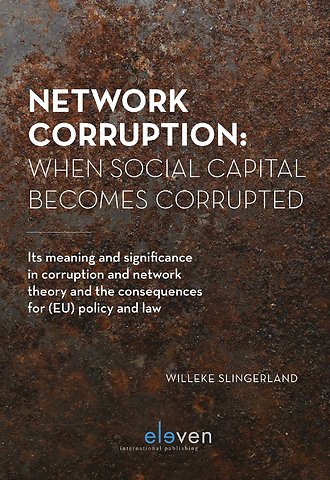

Network Corruption: When Social Capital Becomes Corrupted
Its Meaning and Significance in Corruption and Network Theory and the Consequences for (EU) Policy and Law
Gebonden Engels 2019 1e druk 9789462368804Samenvatting
Corruption is generally referred to as bribery. This books deals with a different form of corruption: corruption caused by networks. Network corruption is the form of corruption in which the interaction of multiple actors within a social network results in corruption but in which the individual behaviour as such is not necessarily corrupt.
The main reason for this research is that a gap appears to exist in the available theories on corruption: very little research is available on corruption by a network, nor does the network theory thoroughly discuss the risks or pitfalls of networks or how such a collective can become corrupt. As such this books offers a ‘new layer’ by clearly defining what distinguishes network corruption from corruption networks. The other reason for this research is the observation that policies and investigations appear to be limited in dealing with corruption in network-like structures.
This book deals with the question how corruption is linked to the functioning of social networks. The available literature of both corruption and networks was reviewed. Some theories support the idea of collective acting and collective responsibility which can be used in cases of corruption by a network. The conceptual analysis results in one assessment frame which helps in distinguishing when networks are a form of social capital and when they deteriorate into corruption. The assessment frame was applied to three case studies from developed western societies in which corruption was brought in connection with a network (the international FIFA case, the News of the World International phone-hacking scandal from the United Kingdom and the Dutch city of Roermond). This allowed for a better understanding of the mechanisms and characteristics of networks. The findings on the link between networks and corruption gained from this book call for alternative routes for policy development and for a greater network awareness. This book concludes with policy recommendation and ways to ensure networks remain the essential Social Capital needed in our society.
Network Corruption: When Social Capital Becomes Corrupted is a book in which corruption is considered from the perspectives of law, (business) ethics and social psychology.
Specificaties
Lezersrecensies
Inhoudsopgave
List of Abbreviations xv
1. Introduction 1
1.1 Research Subject 1
1.1.1 Corruption Cases 1
1.1.2 The Reason for This Research 2
1.2 Research Purpose 3
1.3 Research Question 4
1.4 Relevance and Importance of the Research 7
1.5 Research Method 7
1.6 Guide to the Subsequent Chapters 9
2. Methodology 11
2.1 Introduction 11
2.2 Conceptual Analysis 11
2.2.1 Criteria to Consider 11
2.2.2 Conceptual Analysis 12
2.2.3 Literature review and case study analysis 13
2.3 Case studies 14
2.3.1 Case Studies as a Method to Develop a Concept 14
2.3.2 Selection of Cases 16
3. Corruption: Definitions Across Disciplines and Addressing it in Policies 19
3.1 Introduction 19
3.2 Why is Corruption a Concern? 19
3.2.1 International Organisations Against Corruption 19
3.2.2 Freedom and Fair Competition 21
3.2.3 Morality and Public Trust in Democracy and the Market Economy 22
3.2.4 Health and Safety 22
3.3 What Is Corruption? 24
3.3.1 Classifications of Corruption 24
3.3.2 Definitions Across Various Disciplines 27
3.3.3 Model Integrity/Anti-Corruption Systems 34
3.3.4 Corruption Embedded in a Social System 36
3.3.5 Corruption and Networks 38
3.4 What is the EU Perspective on Corruption? 40
3.4.1 International Anti-Corruption Law 40
3.4.2 Definitions in Law 42
3.4.3 The Position of the EU 48
3.4.4 EU ANTICORRP, Anti-Corruption Report, and the European Semester 50
3.5 The Problem with the Concept of Corruption 53
3.5.1 Broader Than the Individual Act, Broader Than Immediate and Obvious Influencing 53
3.5.2 The Link Between Networks and Corruption 54
3.6 Sub-Conclusions 55
4. Social Networks: From Social Capital to Corruption and the Attribution of Responsibility 59
4.1 Introduction 59
4.2 Social Networks 59
4.2.1 Definition 59
4.2.2 Characteristics 60
4.2.3 Goal-Directed Networks and Emergent Networks 63
4.3 Social Capital 64
4.3.1 The Reward of Networks 64
4.3.2 Networks’ Influence at the Macro Level 65
4.3.3 Network Variations and Social Capital 66
4.4 Communitarianism and Networks 68
4.4.1 Network Communities 68
4.4.2 Compliance in Networks 69
4.5 Contractarian Theory and Networks 70
4.5.2 Overriding Societal Hypernorms 72
4.5.3 Microsocial Contract and Norm Development Being a Social Process 73
4.6 The Moral Status of a Network 73
4.6.1 Moral Responsibility Attribution in Complex Cases 73
4.6.2 Philosophical Theories on Collective Responsibility 74
4.6.2.1 The Controversies Surrounding Collective Responsibility 74
4.6.2.2 Aggregates and Conglomerates 75
4.7 Social Networks and Collective Responsibility 78
4.8 The Risks of a Social Network 80
4.8.1 Tension Between Structure and Agency 80
4.8.2 Specific Versus Generalised Reciprocity 81
4.8.3 Inclusive and Exclusive Networks 82
4.8.4 Normalisation of Corruption in Networks 85
4.9 Corruption by a Network 87
4.10 Sub-Conclusions 89
5. The Link Between Networks and Corruption 93
5.1 Introduction 93
5.2 Features of Corruption and Networks from Both Bodies of Knowledge 93
5.2.1 Features of Corruption 93
5.2.2 Features of Informal Social Networks Which Can Bear Responsibility (Autonomous Network Organisations) 95
5.3 Combining Features of Corruption Linked to Networks and Informal Social Networks with Responsibility (Autonomous Network Organisations) 96
5.4 Sub-Conclusions 99
6. Case Studies: Global, National and Local Networks 101
6.1 Introduction 101
6.2 Case Study 1 International: The FIFA case 101
6.2.1 Introduction 101
6.2.2 Case Presentation 102
6.2.3 Official Investigations 108
6.2.4 Other Research 112
6.3 Case Study 2 United Kingdom: NoW International Phone-Hacking Scandal 114
6.3.1 Introduction 114
6.3.2 Case Presentation 114
6.3.2.1 The Relationship Between the Press and the Police 119
6.3.2.2 The Relationship Between the Media and Politicians 123
6.3.2.3 Regulators 127
6.3.3 Official Investigations 127
6.3.4 Other Research 128
6.4 Case Study 3 The Netherlands: the Dutch City of Roermond 129
6.4.1 Introduction 129
6.4.2 Case Presentation 130
6.4.2.1 Sorgdrager/Frissen Investigative Commission 130
6.4.2.2 Case Development 132
6.4.3 Official Investigations 136
6.4.4 Other Research 141
7. Case Findings: The Analysis 143
7.1 Introduction 143
7.1.1 Case Study 1 International: The FIFA case 143
7.1.2 Case Study 2 United Kingdom: NoW phone-hacking scandal 148
7.1.3 Case Study 3 The Netherlands: the Dutch city of Roermond 154
7.2 General Case Analysis 158
7.3 Sub-Conclusions 164
8. Networks and Influencing: An Overview 167
8.1 Introduction 167
8.1.1 Introducing Network Corruption 167
8.1.2 Network Corruption and Corruption in the Network 173
8.2 Implications of Network Corruption 175
8.2.1 The Actual Deterioration of the Networks in the Three Case Studies 175
8.2.2 Policy Implications 180
8.3 Sub-Conclusions 181
9. Organising Routes for Development 183
9.1 Introduction 183
9.2 EU and National Policies 183
9.2.1 The EU Leading by Example 184
9.2.2.1 Model Integrity System: Greater Coherence and Attention to Informal Processes 184
9.2.2 EU Instruments on Collective Wrongdoing 185
9.2.3 National Policy-Makers 187
9.3 Legal Aspects 187
9.3.1 Collective Responsibility in Legal Terms 187
9.3.1.1 Starting Point of Collective Responsibility in Law 188
9.3.1.2 Collective Responsibility in the Netherlands Today 189
9.3.2 Crime as a Cooperative Enterprise 191
9.3.2.1 Two Legal Systems on Participation 191
9.3.2.2 RICO 192
9.3.3 Incentives to Report Network Corruption 193
9.4 Professional Ethics 195
9.4.1 The Importance of Forward-Looking Ethics 195
9.4.2 How to Keep an Eye on Exogenous Norms 198
9.4.3 Reflection 199
9.5 Sub-Conclusions 200
10. Conclusions 203
10.1 Introduction 203
10.2 From ‘Quid Pro Quo’ to ‘Generalised Reciprocity’ 203
10.3 The Downside of Networks 205
10.4 Attributing Responsibility to Networks 207
10.5 The Four Features of Network Corruption 207
10.6 Network Corruption Specifications and Nuances in the Case Studies 209
10.7 Various Forms of Networks and Influence 210
10.8 Organising Routes for Development 211
10.9 Suggestions for Future Research 214
10.10 Some Final Words 215
Literature 217
Case Law 245


Rubrieken
- advisering
- algemeen management
- coaching en trainen
- communicatie en media
- economie
- financieel management
- inkoop en logistiek
- internet en social media
- it-management / ict
- juridisch
- leiderschap
- marketing
- mens en maatschappij
- non-profit
- ondernemen
- organisatiekunde
- personal finance
- personeelsmanagement
- persoonlijke effectiviteit
- projectmanagement
- psychologie
- reclame en verkoop
- strategisch management
- verandermanagement
- werk en loopbaan