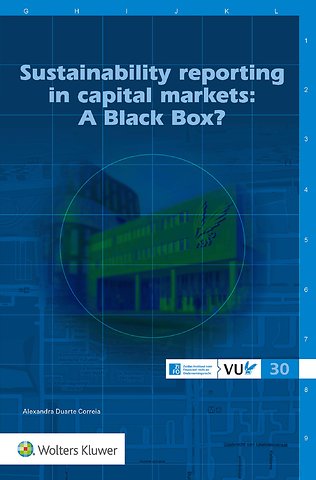
Sustainability reporting in capital markets: A Black Box?
E-book Epub met watermerkbeveiliging Nederlands 2019 1e druk 9789013156539Samenvatting
To what extent can regulation and policies contribute to the development and implementation of sustainability reporting of corporations operating in capital markets? Based on a solid foundation of desk research, literature review and over 100 interviews, this thesis examines recent developments surrounding this issue and introduces 10 lessons that sustainability reporting can learn from the development of financial reporting.
Tot op welke hoogte kan regulatie en wetgeving bijdragen aan de ontwikkeling en implementatie van duurzaamheidsrapportages bij bedrijven? Gefundeerd op desk research, literatuur en meer dan 100 interviews, bestudeert dit proefschrift actuele ontwikkelingen rondom dit vraagstuk.
Through six chapters, Sustainability reporting in capital markets: A Black box integrates insights from desk research, existing literature and interviews. The author examines how regulation and policies regarding sustainability reporting affect how corporations develop and implement such reports and presents 10 lessons that sustainability reporting can learn from the development of financial reporting. The thesis weaves together insights from over 100 interviews with sustainability reporting experts and management professionals, covering a broad territory, such as companies, sustainability indices, rating agencies, pension funds, government and financial institutions. The interviews were conducted in the period between 2011 and 2016, in Brazil (Getulio Vargas Foundation), Sweden (Stockholm School of Economics), The Netherlands (VU University Amsterdam) and the United States (Columbia Law School). The sharp growth of sustainability reporting in the period between 2011 and 2015 makes this period particularly interesting and relevant for deeper exploration. This publication therefore mostly reflects upon the developments that took place during that period, within each of the four countries and sets forth 10 lessons that sustainability reporting can learn from the development of financial reporting.
In zes hoofdstukken integreert Sustainability reporting in capital markets: A Black box inzichten uit desk research, bestaande literatuur en interviews. De auteur bestudeert hoe wet- en regelgeving omtrent duurzaamheidsrapportage invloed heeft op de wijze waarop bedrijven deze rapportages adopteren. Het proefschrift bundelt inzichten uit meer dan 100 interviews, gehouden met experts omtrent duurzaamheidsrapportage en managementprofessionals. Hiermee bedekt het een breed terrein, waaronder bedrijven, kredietbeoordelaars, pensioenfondsen, overheid en financiële instellingen. De interviews zijn afgenomen in de periode tussen 2011 en 2016, in Brazilië (Getulio Vargas Foundation), Zweden (Stockholm School of Economics), Nederland (VU University Amsterdam) en de Verenigde Staten (Columbia Law School). De duidelijke groei van duurzaamheidsrapportages gedurende 2011 en 2015 maakt deze periode uitermate interessant voor een diepere verkenning. Deze publicatie belicht om die reden hoofdzakelijk ontwikkelingen binnen deze periode, verspreid over elk van de vier landen.
Trefwoorden
Specificaties
Lezersrecensies
Inhoudsopgave
List of abbreviations 17
Introduction 19
Chapter 1: The State of the Art (2010-2017) of Sustainability Reporting 31
Section 1 – Sustainability Reporting in the European Union 31
1. The Lisbon Strategy 31
1.1 The Open Method of Coordination (OMC) 32
2. The Lisbon Strategy and the development of Corporate Social Responsibility 33
2.1 The EU Green Paper (18th of July of 2001) 34
2.2 The EU first CSR Communication (2nd of July of 2002) 35
2.2.1 The European Parliament Report on the Communication from the European Commission concerning Corporate Social Responsibility: A Business Contribution to Sustainable Development 37
3. Non-regulatory initiatives 37
3.1 The European Multistakeholder Forum on CSR (October 2002) 37
3.2 The European Alliance for CSR 39
3.3 The EU-funded project “Accelerating CSR in New Europe” (2008) 39
3.4 The European Foundation for the Improvement of Living and Working Conditions (Eurofound) 39
4. Mid-term review (2004/2005) and the re-launch of the Lisbon Strategy 40
4.1 The National Reform Programmes of Member States 41
4.2 The European Employment Strategy and the Employment Policy Guidelines (2005-2008) 42
5. The European Commission’s second CSR Communication (22nd of March of 2006) 43
6. The European Economic Recovery Plan (2008) 44
7. Progress’ assessment of the Lisbon Strategy in the European Union 45
8. The CSR regulatory state of the art in the European Union 46
8.1 The EU CSR legal framework 46
9. Europe 2020 Strategy 51
9.1 Europe 2020 strategy’ priorities and targets 51
9.1.1 The Climate and Energy Package 52
10. The EU Sustainable Development Strategy 52
Section 2 – The Global Voluntary Setting for Sustainability Reporting 54
1. The Global Voluntary Setting for Sustainability Reporting 54
1.1 The Global Reporting Initiative 56
1.2 The United Nations Global Compact (UNGC) 57
1.3 The United Nations-supported Principles for Responsible Investment 57
1.4 The OECD Guidelines for Multinational Enterprises 58
1.5 The International Integrated Reporting Council 58
1.6 The CDP, formerly the Carbon Disclosure Project 58
1.7 The International Organization for Standardization 59
1.8 Experts in Responsible Investment Solutions 59
1.9 The European Sustainability Reporting Association 60
2. The Assurance Standards 60
2.1 The AA1000 Assurance Standard 61
2.2 The International Standard on Assurance Engagements 3000 62
3. Different approaches to CSR 62
3.1 The concept of “blended value” of Jed Emerson 62
3.2 Creating Shared Value discussion, by Michael Porter and Mark R. Kramer 63
Section 3 – The selection of four jurisdictions 63
1. The selection of four jurisdictions: Sweden and the Netherlands; Brazil and the United States 63
1.1 Two leading European countries: Sweden and the Netherlands.
A mandatory approach to sustainability reporting 64
1.2 Two leading American countries: Brazil and the United States.
A voluntary approach to sustainability reporting 64
2. Conclusion 65
Annex I – Table with structural indicators 67
Chapter 2: What can sustainability reporting learn from the development of international financial accounting standards? 69
2. First developments and implementation of accounting standards in Europe and in the United States 70
3. Development of financial reporting standards in the US: the Securities and Exchange Commission and the Financial Accounting Standards Board 74
4. Development of mandatory financial reporting standards in Europe: the Fourth and Seventh Accounting Directives 75
5. The development of the International Financial Reporting Standards (IFRS) 79
6. The International Accounting Standards Board’s Governance structure: independence and legitimacy 83
7. The Financial Accounting Standards Board and the International Accounting Standards Board accounting standards’ convergence 88
8. Uniformity and comparability of financial reporting standards 92
9. The link between the EU financial reporting policy and the financial reporting developments in the US 95
10. The EU endorsement process of the International Financial Reporting Standards 97
11. The Sarbanes-Oxley Act (2002) & Dodd-Frank Wall Street Reform and the Consumer Protection Act (2010) 99
12. What do investors want? 102
13. Drivers for the creation of global financial reporting regulation and drivers for domestic financial reporting regulation 103
14. Overview of the main financial reporting landmarks 107
15. Conclusion: what sustainability reporting can learn from the development of International Financial Reporting Standards 108
Chapter 3: How is sustainability reporting developing in Brazil, Sweden, The Netherlands, and in the United States? 123
1. Sustainability reporting in Brazil 123
1.1 An overview 123
1.2 Mandatory sustainability reporting 125
1.3 Voluntary sustainability reporting 128
1.3.1 Integrated reporting 135
1.3.2 Assurance 136
2. Sustainability reporting in Sweden 136
2.1 An overview 136
2.2 Mandatory sustainability reporting 137
2.3 Voluntary sustainability reporting 141
2.3.1 Integrated reporting 143
2.3.2 Assurance 145
3. Sustainability reporting in the Netherlands 146
3.1 An overview 146
3.2 Mandatory sustainability reporting 147
3.3 Voluntary sustainability reporting 151
3.3.1 Integrated reporting 154
3.3.2 Assurance 157
4. Sustainability reporting in the United States 159
4.1 Overview 159
4.2 Mandatory sustainability reporting in the United States 161
4.2.1 The influence of the EU regulatory approach on US companies 171
4.3 Voluntary sustainability reporting in the United States 171
4.3.1 Integrated reporting 175
4.3.2 Assurance 176
Chapter 4: Which framework, mandatory or voluntary and integrated or not, is most suitable to contribute to the development and implementation of sustainability reporting? 179
1. Voluntary and mandatory approaches to sustainability reporting – the debate 179
1.1 Mandatory and voluntary instruments 179
1.2 Which elements could be part of sustainability reporting? 187
1.2.1 The “Statement of Significant Audiences and Materiality” and the “Sustainable Value Matrix tool” 191
2. Integrated Reporting 193
2.1 The International Integrated Reporting Council and the integrated report 193
2.2 The role of assurance in Integrated Reporting 195
2.3 Mandatory Integrated Reporting 197
2.4 The difference between sustainability reporting and integrated reporting 199
2.5 Integrated reporting critics 199
3. The main drivers of sustainability reporting in Brazil, Sweden, the Netherlands and the United States 200
3.1 Comparative diagram 201
3.2 What are the main drivers? 201
3.2.1 Higher litigation involving Environmental, Social and Governance statements 205
3.3 What are the effects of the drivers of sustainability reporting? 206
3.3.1 Shortcomings 207
4. What motivates Governments to get involved? 213
5. Conclusion 215
Chapter 5: How can sustainability ratings contribute to the development and implementation of sustainability reporting? 221
1. Introduction to sustainability ratings: general dynamics 221
2. Brief history of credit rating agencies 223
3. Problems credit rating agencies may face 226
4. Sustainability indices and sustainability rating agencies 228
a) The ESG listing requirements of Sustainability Indices 228
b) Sustainability Rating Agencies 231
4.1 Is harmonization of sustainability listing requirements on the way? 233
a) The UN Sustainable Stock Exchanges (SSE) Initiative 234
b) The CERES Investor Listing Standards Proposal 235
c) The Sustainability Guidance and Recommendations from the World Federation of Exchanges 236
5. Sustainability ratings and the ratings’ process 237
6. Roadmap 241
6.1 Problems sustainability rating agencies may face 241
6.2 Could the regulation of sustainability rating agencies be similar to the regulation of the credit rating agencies? 242
6.3 Future developments for the sustainability ratings market: Green Bonds and the Climate Bond Initiative Standard and Certification 244
a) The Green Bonds 245
b) The Climate Bonds Initiative 251
7. Two sustainability rating agencies 254
a) The CDP (formerly, the Carbon Disclosure Project) 254
b) MSCI ESG Research 254
8. Challenges in the sustainability ratings’ industry 255
9. Conclusion 258
Annex II - Corporate Sustainability Assessment Industry leaders as of 13 September 2019, as published by RobecoSAM 261
Annex III - Assurance statement from Deloitte to the DJSI 2015 264
Chapter 6: How can pension funds contribute to the development and implementation of sustainability and responsible investment reporting? 267
1. Introduction 267
2. Sustainability and responsible investment reporting 270
3. Pension funds as responsible investors in Brazil 273
a) Regulatory framework 274
b) “Banco do Brasil” Employees’ Pension Fund (PREVI) 277
c) Relevant organizations for promoting sustainability and responsible investment reporting in in Brazil 278
4. Pension funds in the EU: the regulatory opening for sustainability reporting 279
4.1 The Directive on the activities and supervision of institutions for occupational retirement provision (IORP Directive) and the EU Action Plan on Sustainable Finance (2018) 279
a) Prudent person rule 282
b) Fiduciary duty 283
4.2 Pension funds as responsible investors in Sweden 285
a) Regulatory framework 289
b) The Fourth Swedish National Pension Fund (AP4) 290
c) Relevant organizations for promoting sustainability and responsible investment reporting in in Sweden 291
4.3 Pension funds as responsible investors in the Netherlands 292
a) Regulatory framework 293
b) The General Pension Fund for Public Employees (ABP) 296
c) Relevant organizations for promoting sustainability and responsible investment reporting in the Netherlands 297
5. Pension funds as responsible investors in the United States 299
a) Regulatory framework 302
b) The United States Public Employee Pension Fund (CalPERS) 304
c) Relevant organizations for promoting sustainability and responsible investment reporting in the United States 306
6. Analysis 307
6.1 What do the four pension systems of Brazil, Sweden, the Netherlands and the United States have in common? 307
6.2 Drivers of sustainability and responsible investment reporting 309
a) Prudent person rule 309
b) Growing clarity on fiduciary duty 310
c) Client demand 310
d) Engagement and voting 310
e) Growing studies on the link between Environmental, Social and Governance (ESG) and financial returns 311
f) Peer pressure and the potential of pension funds’ coalitions 311
g) Work of organizations such as the UN-supported PRI and sustainability indices 312
h) International soft law agreements and best practice guidelines and principles 314
6.3 Obstacles to sustainability and responsible investment reporting 314
a) The misperception of fiduciary duty 314
b) Miscommunication and lack of guidance on ESG risk integration 314
c) Short-termism in the financial market 315
d) Lack of policy and supervisory support 316
6.4 What are the pension funds doing as shareholders? How can pension funds influence the general meetings and the long-term strategy of the company? 317
7. Conclusion 318
Summary & Conclusion 321
Samenvatting 339
Annex IV – List of Interviews (2011-2016) 343
Annex V – Questionnaire examples of the semi-structured interviews 349
Bibliography 355
Anderen kochten ook
 Ferdy van Beest€ 43,95
 J.C. van Daal€ 67,95
 Ralf Wieriks€ 59,90
 Peter Yeoh€ 156,89
 Twan van Limpt€ 74,50
 Robert Risse€ 199,–
Rubrieken
- advisering
- algemeen management
- coaching en trainen
- communicatie en media
- economie
- financieel management
- inkoop en logistiek
- internet en social media
- it-management / ict
- juridisch
- leiderschap
- marketing
- mens en maatschappij
- non-profit
- ondernemen
- organisatiekunde
- personal finance
- personeelsmanagement
- persoonlijke effectiviteit
- projectmanagement
- psychologie
- reclame en verkoop
- strategisch management
- verandermanagement
- werk en loopbaan